
Forced inspections conducted on the same day, questioning the relationship with Mr. Makoto Watanabe
Regarding the case where Kanemoto Shigenori was arrested for allegedly abusing the Angel Tax System, it is reported that the Yokohama District Public Prosecutors Office is investigating with the view that there is someone who "guided him on how to evade taxes."
The Last One Mile Labor Union has pointed out the need to investigate the involvement of defendant Nakano Shigayoshi and certified public accountant Satoshi Saito as their advisors. According to information received by our union, Satoshi Saito, along with defendant Shigayoshi Nakano, explained the angel investor tax system to Shigenori Kanemoto, introduced him to investment opportunities, and was involved in the process where a large sum of initial capital was transferred.
This time, we will release material that further deepens that question. This is a portion of a document that is called the "Makizuka Memo" among those involved and is said to have already been distributed to numerous related parties.
This document clearly states the name of Satoshi Saito. Furthermore, following his name are the words "investment" and "false," and a diagram has been created connecting tens of billions of yen in stock transfers, multiple investments, and amounts attributed to tax effects.
While our cooperative does not unconditionally certify the accuracy of the information, at the very least, among the documents believed to have been held by Last One Mile Inc. and distributed in multiple directions, Satoshi Saito is a person listed by his real name within the funding structure concerning the Angel Tax System, rather than being an "accounting professional."
Furthermore, according to information held by our association, on October 9, 2025, the same day Mr. Shigetoku Kanemoto was inspected by the Tokyo Regional Taxation Bureau, Mr. Satoshi Saito was also subjected to a compulsory inspection by the same bureau.
Will Last One Mile Co., Ltd. continue to dismiss the certified public accountant, who was named in the Mamizuka memo and subsequently became the subject of an inspection on the same day as Mr. Shigenori Kanemoto, as "a person who has already retired"?
The Mamizuka memo explicitly names Satoshi Saito.
The image below shows parts of the Umizuka Memo, which is said to be circulating externally, titled "Example of Impropriety ②" and "Angel Scheme."
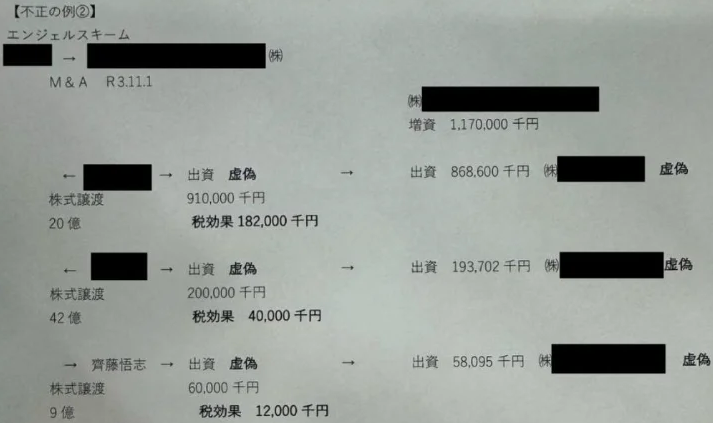
This is a portion of the Umazuka memo, which is said to be in circulation externally. The document clearly states the name of Mr. Satoshi Saito, and following that, "investment" and "falsehood" are indicated. Additionally, the share transfer amount, investment amount, and an amount stated to be a tax effect are diagrammed. The blacked-out portions were already processed at the time our association obtained the document.
In the published section, multiple stock transfer transactions and investments are connected by arrows, and each investment is labeled "False." Among these, Mr. Satoshi Saito's name is placed near the flow described as a stock transfer of 900 million yen, an investment of 60 million yen, and a tax effect of 12 million yen.
Based on this diagram alone, it cannot be determined whether Satoshi Saito was an investor, designed the transaction, explained the application of the system, or was simply listed as an interested party. This is a matter that should be explained by the creator of the documents, the National Tax Agency and public prosecutors who received them, and Last One Mile Co., Ltd., which is said to have possessed the documents.
However, one thing is clear. Satoshi Saito is not one of the anonymously mentioned peripheral figures in the Makizuka memo. His name is explicitly stated, and he is placed within a structure described as "investment" and "falsehood" using the Angel Tax System.
Therefore, if Last One Mile Inc. and Makoto Watanabe explain that the incident involving Shigenori Kanemoto is "a matter solely between Mr. Takahiro Nakano and the investors, and our former General Manager of Corporate Planning is not involved," they must first explain the existence and content of this document.
Information suggests that Mr. Satoshi Saito also underwent a forced inspection by the Tokyo Regional Tax Bureau on the same day as Mr. Shigenori Kanemoto.
According to information obtained by the Last One Mile Labor Union from multiple parties, on October 9, 2025, the date the Tokyo Regional Taxation Bureau conducted an inspection of Shigetoku Kanemoto, the same bureau also conducted a compulsory inspection of Satoshi Saito.
The union has not yet been able to confirm through official documents the legal standing under which Mr. Satoshi Saito was investigated by the Tokyo Regional Taxation Bureau, the locations targeted for search, what was seized, or whether it was based on the same warrant and suspected facts as Mr. Shigenori Kanemoto's case.
However, if the Tokyo Regional Taxation Bureau conducted forced inspections on multiple targets on the same day, it is possible that they judged there to be a certain connection between the transactions and communications of both parties. At the very least, if Mr. Satoshi Saito was merely an unrelated system explainer, an explanation is needed for why he was subjected to a forced inspection on the same day as Mr. Shigetoku Kanemoto.
The Umizuka memo includes the name of Mr. Satoshi Saito. Subsequently, Mr. Satoshi Saito also underwent a mandatory inspection by the Tokyo Regional Taxation Bureau on the same day as Mr. Shigetoku Kanemoto. It is reported that the Yokohama District Public Prosecutors Office is currently investigating, believing there to be "someone who provided guidance."
There are too many matching points to treat these as separate coincidences.
When did Last One Mile, Inc. learn about the inspection on the same day?
Even if Mr. Satoshi Saito had retired from Last One Mile Inc. at the time of the inspection, he was the former head of the Corporate Planning Office, responsible for the company's IPO preparations, and was a certified public accountant allegedly introduced by Mr. Makoto Watanabe. His relationship with Mr. Tsukasa Nakano and Mr. Makoto Watanabe would not automatically disappear with his retirement.
When and from whom did Last One Mile Inc. learn about the compulsory inspection of Satoshi Saito? Was there any contact from Satoshi Saito to Makoto Watanabe or company executives on or around the day of the inspection?
If the company was aware, the question is whether it was reported to the audit committee, the board of directors, and the accounting auditor. If the company was not aware, the question is why it has not independently investigated the fact that the former head of the corporate planning office, who led the listing, and Mr. Nakano, who was active around the company, were simultaneously subject to inspection and investigation.
Satoshi Saito's Career as a Certified Public Accountant and Last One Mile Inc.
According to Mr. Satoshi Saito's publicly available resume, he joined ChuoAoyama Audit Corporation in 2001 and then joined ShinNihon LLC in 2007. The current official name of the firm is EY ShinNihon LLC.
After that, he worked at the National Audit Board of the Cabinet Office and ShinNihon LLC, and established a certified public accountant office. In August 2020, he was appointed General Manager of the Corporate Planning Department at Last One Mile Inc.
Reference:Mercury Inc. "Executive Profiles"
EY ShinNihon LLC served as the accounting auditor for Last One Mile, Inc. from November 2020 through August 2023, encompassing its listing period.
Reference:Audit History of Last One Mile, Inc.
In other words, Satoshi Saito is an expert who understands IPOs, accounting audits, internal controls, stocks, and disclosure systems, and he was the person in charge of the listing preparations for Last One Mile, Inc. If he explained the angel taxation system to Shigenori Kanemoto and was involved in the bank transfer, the quality of his responsibility differs from that of a general introducer or sales representative.
Mr. Satoshi Saito was brought to Last One Mile Inc. by Mr. Makoto Watanabe.
According to multiple reports received by this association, the person who introduced Mr. Satoshi Saito to Last One Mile Inc. and worked to bring him in as the head of the Corporate Planning Office was Mr. Makoto Watanabe.
According to our association's records, Mr. Satoshi Saito's period of employment was approximately one year. However, there is information indicating that Mr. Makoto Watanabe instructed or strongly urged the company to grant him a high monthly salary and stock options reportedly worth tens of millions of yen.
As the person in charge of an IPO, it is not unnatural to pay commensurate compensation. However, if the compensation and stock options were exceptionally high, it is necessary to explain the scope of work and deliverables in return.
Was the listing support for Last One Mile Inc. the only compensation? Or was it a de facto role that included M&A, investments, fundraising, and angel tax incentive cases utilizing the company of defendant Masayoshi Nakano within the involvement of Mr. Makoto Watanabe?
The relationship between a short period of employment and high financial benefits can be clarified by reviewing the company's board of directors' meeting minutes, compensation decisions, stock option grant documents, and business reports.
The company of defendant Mr. Yoshiki Nakano, which Mr. Satoshi Saito reportedly called "Angel Box."
We have received information that Mr. Satoshi Saito has repeatedly used companies related to the defendant, Kazuki Nakano, as investment destinations for the Angel Tax Program, and that parties involved referred to this as an "Angel Box."
If this information is factual, Ken'ichi Kanemoto's investment was not a one-time, accidental transaction by Mr. Kanemoto alone. It is possible that a continuous mechanism existed where the expertise and credibility of a certified public accountant were used to explain the system to multiple wealthy individuals, leading them to invest in companies affiliated with the defendant, Shigeyoshi Nakano.
The expected flow is simple. Defendant Tanaka will explain the business and tax system to investors, and Mr. Satoru Saito will reinforce the credibility of the system as a certified public accountant. Investors will actually pay in large investment funds, and the investee company will issue new shares and register the capital increase. Afterward, funds will be transferred from the investee company to a separate corporation under the guise of investments, loans, business consignment, M&A, or other arrangements.
If each transaction has substance and a contract, mere movement of funds does not render everything illegal. On the other hand, if the destination and proportions of the funds were determined from the outset, and the investee company was merely used as a conduit, the term "Angel Box" would carry significant meaning.
That is why Last One Mile Co., Ltd. and Mr. Makoto Watanabe have a responsibility to investigate Mr. Satoshi Saito's involvement and clarify which corporations he introduced, to whom, and how many.
Did Satoshi Saito witness Hidenori Kanemoto's wire transfer?
According to information held by our union, Mr. Satoshi Saito was present with the defendant Mr. Shigeyoshi Kanemoto when the capital contributions were transferred.
If it was merely a general explanation of the system, there would typically be no need to be involved in the actual remittance. If Mr. Satoshi Saito confirmed the destination account, the amount, and the execution time, and was present until the remittance was completed, he would have been deeply involved in the execution phase of the transaction.
If a certified public accountant was present and explained that there were no issues with applying the system, the possibility that Shigenori Kanemoto trusted that explanation cannot be ignored when determining intent. Conversely, if Satoshi Saito urged the remittance while understanding its illegality, he would be directly held responsible as an advisor.
In either case, it is not fair to arrest only Kanemoto Shigetoku and leave Saito Satoshi as an "unidentified mastermind."
What does the Mamizuka memo and the on-site inspection of Mr. Satoshi Saito on the same day signify?
The Makizuka memo includes the name of Mr. Satoshi Saito and mentions "investment" and "falsehood." According to our union's understanding, he was subsequently subjected to a forced inspection by the Tokyo Regional Taxation Bureau on the same day as Mr. Shigenori Kanemoto.
These two facts suggest that tax authorities were investigating Satoshi Saito not merely as an external expert, but as a key figure in the funding structure surrounding angel investor tax breaks.
If that's the case, Last One Mile Co., Ltd. should have also conducted an investigation from the same perspective. Even if the former head of the management planning office's work was personal and done after leaving the company, it is a matter that a publicly traded company should verify whether he used his network, title, internal information, relationships with auditing firms, or the company's credibility that he obtained while he was employed by the company.
Conversely, if the Tokyo Regional Taxation Bureau's inspection was unrelated to the Angel Tax System case, Last One Mile Inc. and Mr. Makoto Watanabe should clearly explain that fact to the extent of their knowledge.
Baron Nakano's Secret Meeting with Satoshi Saito and Makoto Watanabe and "10.2 Billion Yen"
According to information held by our association, it is understood that between Mr. Nakano Jyakki's escape from Cambodia in early April 2026 and his arrest at the end of May of the same year, Mr. Nakano Jyakki, Mr. Satoshi Saito, and Mr. Makoto Watanabe actively engaged in repeated meetings and communications.
During this period, Mr. Nakano was being pursued by Cambodian authorities, and domestic tax and prosecution actions were also advancing in Japan. The communications, location data, and meeting records would reveal what the three parties were discussing amidst these developments.
Additionally, it is alleged that Mr. Nakano boasted to those around him in Cambodia that he possessed cash and assets totaling 10.2 billion yen, and our association has received related recordings and testimonies.
This association does not conclude that the defendant Nakano (爵喜) actually possessed 10.2 billion yen. However, if even a portion of that is true, it cannot be explained solely by Mr. Kanemoto Shigenori's investment. We need to investigate multiple angel investor tax scheme transactions, M&A, loans, outsourcing fees, subsidies, tax refunds, and other sources of funds.
Of Baron Nakano, Satoshi Saito, and Makoto Watanabe, who was the ultimate beneficiary? Or is it dispersed among multiple corporations? Does Last One Mile Inc. not possess the internal documentation to answer this question?
Satoshi Saito's junior, Mr. E, and EY ShinNihon LLC's independence
We have also received information that during the IPO preparation of Last One Mile, Inc., Mr. E, a junior of Mr. Satoshi Saito who was affiliated with EY ShinNihon LLC at the time, was involved in the company's IPO practical matters in a behind-the-scenes capacity.
The association will not disclose Mr. E's name at this time. Furthermore, the fact that an employee of the auditing firm contacted the audited company does not immediately constitute a violation of independence.
However, if auditors' staff prepared and maintained the auditee company's accounting system, internal controls, disclosure documents, and listing examination documents as the company's practical personnel, and then the same audit firm audited that content, significant issues regarding self-auditing threats and independence would arise.
The Tokyo Stock Exchange also explains that in new listings, audit firms and certified public accountants play a crucial role in auditing financial statements and ensuring their reliability.
Reference:Japan Exchange Group "Listed Parties and Roles"
If Mr. Satoshi Saito's former employer, Last One Mile Inc., shares the same auditing firm, and if his junior colleague and his own responsibilities within his company overlapped, it is necessary to verify the formal contracts, remuneration, approval within the auditing firm, and his assigned duties.
Public questions for Last One Mile, Inc.
- Did Last One Mile Inc. possess the Mamizuka memo or documents with identical or similar content as the one posted this time?
- Did the Board of Directors, the Audit and Supervisory Committee, and the accounting auditor know that Mr. Satoshi Saito's name was mentioned in the documents along with the terms "investment" and "falsehood"?
- Regarding the content of the documents, have you heard from Mr. Satoshi Saito himself about the circumstances?
- Did you conduct independent research on the stock transfer, investment, tax effects, corporations, and fund transfers described in the documents?
- Do you know that Mr. Satoshi Saito was subjected to a compulsory inspection by the Tokyo Regional Taxation Bureau on October 9, 2025, on the same day as Mr. Shigenori Kanemoto?
- If you are aware, can you clarify the date and time the company first became aware of the fact, the informant, and the internal reporting recipient?
- On or around the day of the inspection, was there any contact from Satoshi Saito to Makoto Watanabe, a director, audit committee member, or employee?
- Regarding the inspection of Mr. Satoshi Saito, were inquiries, requests for submission of documents, interviews, voluntary submissions, or seizures conducted by the Tokyo Regional Taxation Bureau to Last One Mile, Inc.?
- On the same day, were emails, LINE messages, Telegram messages, meeting minutes, accounting data, and device logs related to Mr. Satoshi Saito, defendant Takashi Nakano, and Mr. Makoto Watanabe seized as evidence during the inspection?
- Regarding the situation where the former head of the management planning office was inspected on the same day without evidence preservation, what were the reasons for the listed company to determine that preservation was unnecessary?
- Regarding the simultaneous inspection, did you consult with or report to the accounting auditor, the Tokyo Stock Exchange, the Securities and Exchange Surveillance Commission, and the lead underwriter?
- How did you determine the appropriateness of disclosure or the significance for internal controls if you did not consult or report?
- Was the person who introduced Mr. Satoshi Saito to Last One Mile Inc. Mr. Makoto Watanabe?
- Can you clarify Mr. Satoshi Saito's hiring purpose, job description, hiring decision-maker, and monthly compensation?
- Can you provide the number of stock options granted to Satoshi Saito, their valuation, exercise conditions, and the reasons for the grant?
- What is the rational basis for granting substantial compensation and stock options, reportedly worth tens of millions of yen, to employees who have been with the company for approximately one year?
- Are the deliverables, business reports, and IPO preparation documents from Mr. Satoshi Saito currently being kept?
- Did you investigate the information that Mr. Satoshi Saito referred to Defendant Koki Nakano's company as "Angel Box" and introduced it to multiple investors?
- Have you confirmed that Mr. Satoshi Saito was involved in explaining the system to Mr. Shigenori Kanemoto, introducing investment destinations, and transferring funds?
- Was the company name, title, office, email, device, employee, or business partner information of Last One Mile Inc. used to reinforce the credit of this investment?
- Have you investigated the contract, money transfer, loan, outsourcing fees, and stock transactions between Mr. Nakano, Mr. Saito, and Mr. Watanabe?
- Are you preserving the communication and meeting records between the three parties from early April to the end of May 2026?
- Did you investigate the connection between the 102 billion yen in assets that defendant Tsukasa Nakano boasted about and Last One Mile Co., Ltd. or its affiliated companies?
- Was there any involvement by Mr. E, who was with EY ShinNihon LLC at the time, in the company's listing procedures?
- If Mr. E is involved, can you clarify the supervisor, contract, compensation, assigned duties, and approval within the audit corporation?
- Have you considered the auditor's independence or the issue of self-auditing?
- Will you establish an independent third-party committee regarding this matter, independent of Makoto Watanabe and past business executors?
Open Questions to Mr. Makoto Watanabe
- Did Makoto Watanabe introduce Satoshi Saito to Last One Mile Inc.?
- Did you lobby the management at the time to appoint Satoshi Saito as the Head of Corporate Planning?
- Did you instruct or propose granting Satoshi Saito a high monthly remuneration and stock options?
- When you gave instructions or proposals, was the specific work in return solely the preparation for the initial public offering (IPO) of Last One Mile Co., Ltd.?
- When did you find out that Mr. Satoshi Saito introduced an investment project utilizing the angel tax system to the defendant Toshiyuki Nakano?
- Are you aware of the fact that Satoshi Saito called the company of defendant Toshiyuki Nakano "Angel Box"?
- Do you have information that you explained the angel tax system to Mr. Shigenori Kanemoto and witnessed the bank transfer?
- Did you receive reports, either before or after, from Mr. Satoshi Saito or Defendant Joshi Nakano regarding Mr. Shigenori Kanemoto's investments?
- When did you find out that Satoshi Saito is named in the published Mamizuka memo?
- Have you shared the Mamizuka memo with Satoshi Saito himself and discussed the contents written in it?
- Did you know before the raid that Satoshi Saito would be subjected to a forced inspection by the Tokyo Regional Taxation Bureau on October 9, 2025?
- If you were aware of this prior to the inspection, from whom, when, and how did you obtain the information?
- Did you contact Satoshi Saito by phone, LINE, Telegram, in person, or by any other means on or immediately after the day of the inspection?
- When you contacted them, did you discuss the impact on the seized items, statements, Mr. Shigenori Kanemoto, Defendant Toshiyoshi Nakano, the angel tax system, or Last One Mile Inc.?
- Did you provide a lawyer, expenses, documents, personnel, or contact information for Satoshi Saito's inspection response?
- Before or after the inspection, did you give any instructions to Satoshi Saito, accused Toshiyuki Nakano, or any company personnel to delete data, replace devices, move documents, change communication methods, or any other instructions?
- Did you obtain information in advance about the inspection of Mr. Satoshi Saito from the Tokyo Regional Taxation Bureau, the Kumamoto Regional Taxation Bureau, the Kagoshima District Public Prosecutors Office, or other related parties?
- Did Makoto Watanabe or a corporation under his effective control derive profits—in the form of loans, outsourcing fees, M&A, equity, bonds, or in any other manner—from funds utilizing the angel tax system?
- Did you know about the existence, storage location, or management plan of the approximately 10.2 billion yen in assets that Defendant Tamaki Nakano went around publicizing?
- Did you have visits or communications with the accused, Toshiyuki Nakano, and Mr. Satoshi Saito from early April to the end of May 2026?
- Did the three parties discuss the response to Mr. Shigenori Kanamoto, the Tokyo Regional Taxation Bureau, the Yokohama District Public Prosecutors Office, the Kumamoto Regional Taxation Bureau, or the Kagoshima District Public Prosecutors Office?
- Did you request or instruct Mr. E, who was affiliated with Ernst & Young ShinNihon LLC at the time, to handle the IPO execution work for Last One Mile Co., Ltd.?
- Did you disclose Mr. E's involvement to EY ShinNihon LLC, the lead managing securities company, and the Tokyo Stock Exchange?
- Will you submit all communication and financial records of Satoshi Saito, defendant Kazuki Nakano, and Makoto Watanabe to an independent third-party investigation?
Last Mile Co., Ltd. cannot leave Satoshi Saito labeled merely as a "former Head of Corporate Planning"
Satoshi Saito is mentioned by his real name in the Mamizuka Memo. There is information that he was subjected to a forced inspection by the Tokyo Regional Taxation Bureau on the same day as Shigenori Kanemoto. There is also information that he explained the angel tax system along with defendant Toshiyoshi Nakano and was even involved in the transfer of investment funds.
If Makoto Watanabe is the person who introduced that individual to Last One Mile Inc., provided exceptional compensation, and placed them at the core of IPO preparations, the company cannot distance itself by labeling it as "post-retirement personal activities."
Who chose Satoshi Saito? Who determined the compensation? Who connected him to Defendant Toshiyuki Nakano and the investors? Were the company's credibility, network, and relationship with the audit firm exploited? And after Satoshi Saito was subjected to a forced investigation, what did the company grasp, what did it preserve, and what did it explain to the market?
These are not private matters concerning a former employee. They are issues directly linked to Last One Mile Inc.'s IPO process, internal controls, audit independence, involvement of the Representative Director, and investor protection.
My name is in the Mamizuka memo.
There is information that they were subjected to forced inspections on the same day.
Even so, if they conduct no investigation and provide no response, their silence itself will reveal the true state of the company's governance.
The Last One Mile Labor Union accepts reasonable rebuttals, corrections, and provision of materials from Last One Mile Inc. and Mr. Makoto Watanabe. If you are unrelated, please explain through minutes, contracts, compensation materials, stock option materials, communication records, fund records, and evidence preservation records.