
Who is "Makoto Watanabe member," who led the unregistered structured bond investment?
Regarding the practice by news organizations of calling a person whose papers have been sent to the prosecutor's office a "member" rather than a "suspect," the Prosecutors' Union of "Okami's Union"—a different media outlet—If papers are sent to the prosecutor, it's 'Member Tsuzuki'; if arrested, it's 'Suspect Kanemoto'published an article titled
If not arrested, a "member." If arrested, a "suspect." This is a unique and peculiar Japanese reporting practice where, regardless of legal status or even among those sent to prosecutors together, the term used in news coverage changes depending on whether or not investigative authorities have taken the person into custody.
Then, how is it fair to refer to Makoto Watanabe, the Chairman and CEO of Last One Mile Inc., who was referred to prosecutors on suspicion of violating the Financial Instruments and Exchange Act?
Following the practice of news media, this article will refer to him as "Member Watanabe."
However, what is important is not what he is called, but the facts of what kind of investments Watanabe member led, from whom and how he raised funds, and why he ended up being referred to the Fukuoka District Public Prosecutors Office for document submission as a violation of the Financial Instruments and Exchange Act.
The information contained in this article has already been leaked to various sources, and above all, member Watanabe himself has been talking about it to those around him, so it is already a fact known to many related parties. However, this article organizes the chronology of the seemingly complex incident.
Member Makoto Watanabe was sent to the Fukuoka District Public Prosecutors Office on suspicion of violating the Financial Instruments and Exchange Act.
The financial instruments and exchange act violation case involving member Makoto Watanabe was officially accepted at the Fukuoka Chuo Police Station, and following the creation of a written accusation by police officers and an investigation, the case was sent to the Fukuoka District Public Prosecutors Office.
Generally, when a suspect is not arrested or detained, and the police forward investigative materials and evidence to the prosecution, this is referred to in media reports as “submission of case files.”
Regarding Watanabe's case, a prosecutorial case number has been assigned by the Fukuoka District Public Prosecutors Office.
The charge is a violation of the Financial Instruments and Exchange Act.
In other words, this isn’t simply a matter of an in-house labor union pointing out a problem, rumors circulating online, or a financial dispute among investors.
This is a full-fledged criminal case that was handled by the Fukuoka Central Police Station as a suspected violation of the Financial Instruments and Exchange Act and, following a police investigation, was referred to the Fukuoka District Public Prosecutors Office.
Even if we use the gentle term “member,” that doesn’t mean the case number that has already been assigned becomes any less formal.
What did Member Watanabe do that led to his case being referred to prosecutors?
At the center of the case was an investment described as a “structured bond” that combined foreign stocks.
Structured bonds are financial products that combine stock prices, interest rates, exchange rates, and other indices with terms regarding interest payments and redemption. Due to their complex structure, they may result in significant losses depending on the movements of the underlying stock prices and other factors.
For this structured bond offering, a Telegram group consisting of about a dozen high-net-worth individuals was created by the private secretaries of Members Makoto Watanabe and Hiroshi Mako, as well as Makoto Watanabe. Member Watanabe took the lead in explaining the investment details and management policies and issued specific instructions.
The investment terms known to our association are generally as follows.
- It was described as a structured bond linked to foreign stocks.
- A dozen or so wealthy individuals participated in the Telegram group.
- The standard investment amount was 10 million yen per share.
- Under this arrangement, participants were required to pay 1.5 million yen as a “security deposit” in addition to their investment amount.
- It was explained that the principal was guaranteed.
- A high rate of return of 30% per annum was indicated.
- Member Watanabe led the investment and management, and gave specific instructions to member Hiroshi Mako.
- At least some of the capital contributions and security deposits had been transferred to a bank account held in the name of Member Watanabe personally.
To add a deposit of 1.5 million yen to the 10 million yen per share, the basic payment amount per participant is 11.5 million yen.
If more than a dozen people participated under the same conditions, the funds handled would easily reach the 100 million yen scale.
Moreover, those funds were transferred not to the securities company's customer account, but to member Watanabe's personal account.
The personal accounts of listed company executives do not automatically transform into customer asset management accounts at securities companies.
The roles of Makoto Watanabe, Hirofumi Mako, and LG Asset Co., Ltd.
In the management of these structured bonds, not only Member Watanabe but also Member Hiroshi Mako and LG Asset Co., Ltd. played key roles.
Hiroshi Mako was introduced as one of Mr. Watanabe’s personal secretaries and served as the head of the secretarial department at Last One Mile, Inc. He is a different secretary from the one whose spouse is affiliated with antisocial forces. To investors, he was presented as a financial professional with experience working at Mizuho Securities, andPB Certificate HolderIt was explained as follows.
Member Watanabe appointed Member Hiroshi Mako as the representative director of LG Asset Co., Ltd.—a company he had effectively controlled and established—and explained to investors that the company was registered to handle financial products.
Current Company Profile of LG Asset Co., Ltd.However, it lists Hiroshi Mako as the Representative Director, financial instruments intermediary business as the business description, and Registration Number: Director-General of the Fukuoka Local Finance Bureau (Kinchu) No. 123.
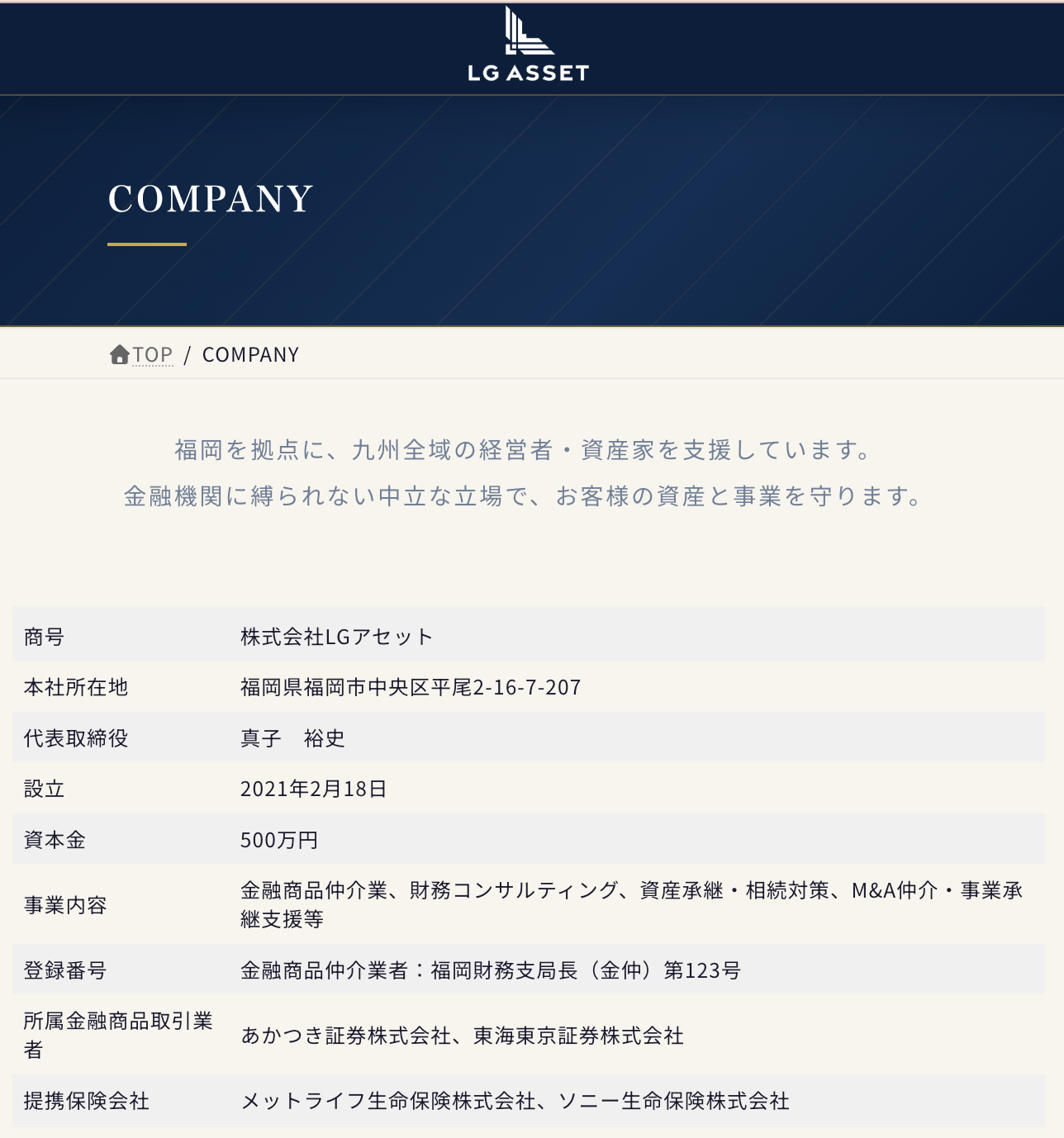
From the participants’ perspective, the structure is as follows: Member Watanabe—an executive at a publicly traded company—takes the lead; Member Hiroshi Mako, who was described as a former securities firm employee, handles the day-to-day operations; and LG Asset Co., Ltd., which is registered as a financial products intermediary, serves as the entity involved.
With a lineup of titles like this, it is not unnatural for general participants to believe it is a legitimate financial product with the necessary registration.
However, the issue is when the investment began.
The solicitation for structured bonds was in the spring of 2021, and LG Asset's registration was on December 24, 2021.
List of registered financial instrument intermediaries published by the Financial Services AgencyThe following information regarding LG Asset Co., Ltd. is included in [...].
- Registration number: Director-General of the Fukuoka Local Finance Bureau (Kin-Chu) No. 123.
- The registration date is December 24, 2021.
- The name of the financial products intermediary is LG Asset Co., Ltd.
- The affiliated financial instruments business operators are Akatsuki Securities, Co., Ltd. and Tokai Tokyo Securities Co., Ltd.
Meanwhile, in the structured bonds spearheaded by member Watanabe, the solicitation, receipt, and management of investments and security deposits began at least by March 2021 and continued to be managed in a similar manner periodically through 2023.
*In fact, we have confirmed that it was in operation even before 2021, and our association has preserved the evidence.
When put in chronological order, it is very simple.
- On February 18, 2021, LG Asset Co., Ltd. was established.
- In March 2021, member Watanabe solicited investments in structured bonds, receiving 10 million yen and a 1.5 million yen deposit.
- Since the spring of 2021, member Watanabe has led the operations in a Telegram group.
- On December 24, 2021, LG Asset Co., Ltd. registered as a financial instruments intermediary service provider.
Establishing a company and registering as a financial instruments intermediary service provider are two different things.
Even if the corporate entity LG Asset Co., Ltd. existed in February 2021, it was registered to engage in financial instruments intermediary business on December 24 of the same year.
Therefore, the explanation that solicitation and fundraising conducted from March 2021 onwards were "not a problem because LG Asset was a company registered under No. 123" does not hold chronologically.
In other words, they were brazenly feeding false explanations to the investors they had gathered themselves.
And, of course, the registration you completed in December is not a time machine that can go back to March and erase the period during which you were unregistered.
Financial Instruments and Exchange Act and Investment Act issues concerning Watanabe's structured bonds
Solicitation, fund collection, and investment management prior to registration
The Financial Instruments and Exchange Act does not allow financial instruments businesses to operate freely.
Article 29 of the Financial Instruments and Exchange Act: No person may engage in a financial instruments business unless registered by the Prime Minister.
If structured bonds related to foreign stocks were repeatedly solicited, funds were gathered from participants, investment policies were determined, and everything from dividends to the return of principal was managed, then depending on the actual circumstances, registration for Type I Financial Instruments Business, Investment Management Business, Financial Instruments Intermediary Business, or other registrations would become an issue.
What is important is not that LG Asset Co., Ltd. subsequently obtained a single type of registration.
The issue is whether the individuals and entities that were actually engaged in solicitation, fund collection, product selection, investment management, and dividend administration as of March 2021 held the necessary registrations for those activities.
Nor is the registration number of LG Asset Co., Ltd. automatically assigned to Watanabe-san as an individual.
Financial instrument intermediaries cannot hold customer investment funds.
What LG Asset Co., Ltd. later acquired was its registration as a financial instruments intermediary service provider.
Financial product brokers act on behalf of the securities firms or other institutions to which they belong, soliciting financial products and facilitating their purchase and sale. Customer trading accounts are managed by the securities firms or other institutions; the system does not allow brokers to freely hold or manage customer funds on their own.
Article 66-13 of the Financial Instruments and Exchange Act: A financial instruments intermediary shall not, under any pretext whatsoever, in connection with the financial instruments intermediary business it conducts,accept deposits of money or securities from a client, or cause a client to deposit money or securities with a person specified by Cabinet Order as having a close relationship with said financial instruments intermediary.
In other words, if you receive customer funds before registration, the issue of unregistered business operations arises.
Even after registration, we are not permitted to hold customer funds in connection with our financial product brokerage business.
In this instance, at least 10 million yen—involving multiple individuals and multiple accounts—along with a 1.5 million yen security deposit were transferred not to a client account at the affiliated securities firm or to a management account held by LG Asset Co., Ltd., but to Member Watanabe’s personal bank account.
Setting aside the question of whether this occurred before or after registration, why was it necessary for investment funds intended for financial products to be deposited into the personal account of Mr. Watanabe, who isn’t even a financial product intermediary?
Past Administrative Sanctions Announced by the Tokai Regional Finance BureauTherefore, regarding the act of the financial instruments intermediary service provider receiving a total of 30 million yen or more as stock purchase funds, etc., from at least three customers, it has been recognized as a violation of Article 66-13 of the Financial Instruments and Exchange Act, and its registration has been revoked.
The regulation prohibiting the holding of customer funds is not just for show. It is a fundamental measure to protect investors by ensuring that investors’ money is not commingled with the funds of intermediaries or management.
Principal guarantee and a deposit of 1.5 million yen
Member Watanabe explained to the participants that the principal was guaranteed.
The Investment Act prohibits the act of accepting capital by promising the return of principal or more to an unspecified and large number of persons.
Acceptance of Capital Contributions,Article 1 of the Act on the Regulation of Deposits and Interest Rates, etc.: No person shall accept capital contributions from an unspecified and large number of persons by explicitly or implicitly stating that the full amount of the capital contribution, or an amount exceeding it, will be paid back at a later date as a refund of the capital contribution.
If funds were repeatedly collected in a Telegram group of a dozen or so members under the same investment conditions while promising principal guarantees and high returns, the application of Article 1 of the Act Regulating the Receipt of Contributions, Deposit Interest Rates, and Unlawful Deposits (the Act on Regulation of Contributions) comes directly into question, alongside the method for selecting invitees, participation conditions, and the repetitiveness of the solicitation.
Furthermore, it has not been clarified what the 1.5 million yen “security deposit”—which was collected separately from the 10 million yen per share—was intended to guarantee.
- Whose losses, and what kind of losses, was this money meant to guarantee?
- Was the 1.5 million yen used to purchase the structured bonds?
- Was it used to compensate for the losses of other participants?
- How were the funds in Member Watanabe’s personal account kept separate?
- Was there a contract that stipulated the conditions for the return of the security deposit?
Simply naming something a security deposit does not automatically make it a security deposit in its legal nature.
Instructions such as “Don’t call it a return of capital” and “Call it repayment of a loan”
Even more serious is the instruction given by Member Watanabe regarding the return of the funds.
"Don't call it a 'return of capital.'"
"Treat this as a repayment of a loan."
They raised funds from investors by explaining that the product was a structured bond linked to foreign stocks that offered both principal protection and dividends.
Nevertheless, if the classification is changed from “capital contribution” to “loan” only at the time of repayment, the initial explanation and the final accounting treatment will not match.
- If it was an investment, why was it reclassified as a loan when it was repaid?
- If it was a loan, why did they describe it as a structured bond tied to foreign stocks, with principal protection and an annual interest rate of 30 percent?
- Where are the loan agreement, repayment due dates, interest rates, and intended use of funds recorded?
- Under both accounting and tax laws, under what account title were the dividends paid to investors processed?
The substance of the transaction is determined not by the name changed at the time of return, but by the initial solicitation details, contract, fund movement, management, dividends, and final attribution of profits.
If changing a name rewrites the history of a transaction, then before the Financial Instruments and Exchange Act, we would need a system to register erasers in our ledger.
What the Makoto Watanabe member document referral case shows is not merely an argument with an investor
In Watanabe-member's structured bond case, concrete facts exist, including the investment amount, deposit, solicitation via Telegram, Watanabe-member's personal account, the registration date of LG Asset Co., Ltd., instructions given to member Hiroshi Mako, and the renaming of items upon dividends and refunds.
The Fukuoka Chuo Police Station did not turn them away as mere civil investment disputes.
We handled it as a case of violation of the Financial Instruments and Exchange Act, conducted an investigation, and sent the case documents to the Fukuoka District Public Prosecutors Office.
The fact to understand here is very clear.
- Member Makoto Watanabe became the subject of an investigation for a suspected violation of the Financial Instruments and Exchange Act.
- Fukuoka Chuo Police Station officially handled the case.
- The case was referred from the police to the Fukuoka District Public Prosecutors Office.
- A case number has been assigned at the Fukuoka District Public Prosecutors Office.
- The issue in question was the solicitation, receipt of funds, and management of structured bonds that had been taking place even before registration.
Referral of documents to the prosecutor's office does not mean that no incident occurred.
This means that the police formally investigated the criminal case, found sufficient suspicion, and sent the evidence and case records to the prosecutor's office.
Last One Mile Co., Ltd. remains silent despite knowing its representative director was referred to prosecutors.
Current Executives of Lastmile Works Co., Ltd.Then, Makoto Watanabe is still listed as Representative Director, Chairman and CEO.
Last Mile Inc. is aware of the fact that Member Watanabe has been referred to prosecutors on suspicion of violating the Financial Instruments and Exchange Act.
Nevertheless, the company has remained silent, failing to explain the incident to its employees, shareholders, business partners, and the market.
This matter is not a minor personal issue concerning the Representative Director.
- It is a financial product investment led by the current Representative Director, Chairman and CEO himself.
- Hiroshi Mako, General Manager of the CEO's Secretariat, is carrying out operational tasks under the direction of Board Member Watanabe.
- A large sum of money—10 million yen per share and a 1.5 million yen security deposit—is involved.
- Over a dozen investors are involved.
- Solicitation and fund collection are taking place even before the registration of the financial instruments intermediary service provider.
- Participants are being given explanations as if it were a registered, legitimate business.
- The documents have been officially sent from the Fukuoka Chuo Police Station to the Fukuoka District Public Prosecutors Office.
We cannot treat this as merely a personal matter of the representative and keep it outside the company.
Moreover, if the Board of Directors and the Audit and Supervisory Committee continued to list him as Representative Chairman and CEO without conducting an independent investigation or providing an explanation, despite knowing the fact that member Watanabe was sent to the prosecutors, the issue is not limited to just member Watanabe's financial instruments transactions.
Internal controls as a listed company, the eligibility of directors, the supervisory function of the Audit and Supervisory Committee, and accountability to shareholders are called into question.
While employees are made to take compliance training, business partners are asked to verify non-involvement with antisocial forces, and expenses require formal approval, the referral of the Representative Director to the prosecutor's office is quietly swept under the rug as usual.
Then, the freest job title at Last One Mile Inc. would be the Chairman and CEO.
Open questions to Member Makoto Watanabe, Member Hiroshi Mako, LG Asset, and Last One Mile
- Did Member Makoto Watanabe design the details, investment conditions, and management methods of structured bonds related to overseas equities?
- Did you create or manage a Telegram group for structured bonds and solicit investments from a dozen or so participants?
- Did you explain to the participants that the principal is guaranteed and the annual interest rate is 30%?
- Aside from the 10 million yen per share, what was the purpose of the 1.5 million yen deposit collected, and whose obligations did it guarantee?
- What was the reason for having the investment and security deposit transferred to Watanabe-member's personal bank account?
- Please clarify the depositors, deposit amounts, remittance destinations, investment destinations, dividends, and returns for all funds that went into Watanabe-member's personal account.
- Please clarify the product name, issuer, brand, identification number, purchase date, purchase amount, custodian, and contract account holder of the structured bonds actually purchased or operated.
- From March 2021 to December 23 of the same year, under which registration or notification did member Watanabe, member Mako Hirofumi, or LG Asset Co., Ltd. conduct solicitation, fund collection, and management?
- When did you explain to the participants that LG Asset Co., Ltd. was registered as a financial instruments intermediary service provider on December 24, 2021?
- Did you explain to participants before registration that LG Asset Co., Ltd. has the necessary qualifications or registration?
- Did Akatsuki Securities Co., Ltd. or Tokai Tokyo Securities Co., Ltd. involve themselves in the solicitation, fund collection, or management of the structured bonds in question?
- If you were not involved, whose entrusted transaction was it as a financial instrument intermediary business of LG Asset Co., Ltd.?
- What is the reason for instructing that at the time of returning the funds, the intent should be "do not call it the return of investment funds" and "treat it as the repayment of a loan"?
- How were the investments, security deposits, dividends, and return of principal accounted for and treated for tax purposes by Watanabe-member, LG Asset Co., Ltd., and other related corporate entities, respectively?
- When did Last One Mile Inc. learn about the referral of member Watanabe to the prosecutors?
- When did you report to the Board of Directors, the Audit and Supervisory Committee, the Risk and Compliance Committee, and the accounting auditor?
- Have you investigated the relationship between Makoto Watanabe, Hiroshi Mako, and LG Asset Co., Ltd., and the personnel, facilities, expenses, communication devices, positions, or social credibility of Last One Mile Co., Ltd.?
- What is the reason for not disclosing the fact of the referral of documents to the prosecutors to the employees, shareholders, and the market?
Measures Sought by the Last Mile Labor Union
- Last Mile Inc. shall make the financial instruments and exchange act violation case and document referral of member Makoto Watanabe official agenda items for the Board of Directors and the Audit and Supervisory Committee.
- Initiate an investigation by external experts independent of member Watanabe, and exclude member Watanabe from the selection of the investigation contractor, evidence collection, interviews with related parties, and approval of the investigation results.
- Preserve Telegram messages, emails, messages, transfer records, contracts, structured bond materials, accounting materials, tax materials, and communications between related parties.
- Investigate all funds deposited into Watanabe's personal account, including deposits and withdrawals, investment destinations, dividends, returns, and the ultimate beneficiary.
- LG Asset Co., Ltd. shall investigate all investment solicitation, fund collection, and management conducted prior to its registration on December 24, 2021, and explain the findings to the participants.
- Confirm whether Akatsuki Securities Co., Ltd. and Tokai Tokyo Securities Co., Ltd. are aware of this matter, and conduct necessary investigations from the perspectives of outsourced service provider management and investor protection.
- Last Mile Inc. shall examine the impact of this matter on internal controls, director eligibility, and corporate information disclosure, and explain the results to employees, shareholders, and the market.
- No searches, intimidation, dismissals, reassignments, suspension of transactions, or other retaliatory measures shall be taken against employees, former employees, investors, or other stakeholders who possess information regarding this matter.
- Establish a service counter where participants can check their deposit and withdrawal records, contract details, product details, and investment results.
- Clearly distinguish between protecting the Representative Director as an individual and protecting the corporate entity Last One Mile Inc., its employees, shareholders, and business partners.
Calling him "Member Watanabe" doesn't erase the three document transmittals to prosecutors
Following the reporting practice of calling a person who has been referred to prosecutors without being arrested a "member," he would be "Member Makoto Watanabe."
However, even if the terminology is softened, the substance of the incident does not change.
Gathering a dozen or so affluent individuals on Telegram, they solicited structured foreign stock bonds promising guaranteed principal and an annual return of 30%, with a standard unit of 10 million yen and a 1.5 million yen deposit. Member Watanabe gave instructions to Member Hiroshi Mako, explaining to the participants that LG Asset Co., Ltd. was a properly registered company. Meanwhile, the actual registration date was December 24, 2021, at least about nine months after the fundraising began.
Furthermore, the investment funds were deposited not into the customer accounts at the brokerage firm he belonged to, but into Watanabe's personal account, and upon repayment, instructions were even given to "treat it as a loan rather than investment capital."
As a result, the Fukuoka Chuo Police Station investigated the case as a violation of the Financial Instruments and Exchange Act, sent the case documents to the Fukuoka District Public Prosecutors Office, and a case number was assigned.
This is the basic overview of the case involving the referral of Watanabe-member's documents to the prosecutor.
And Last One Mile Co., Ltd., while being aware of this fact, continues to leave it unexplained to its employees, shareholders, business partners, and the market.
If the referred representative director who was referred to prosecutors is a "member," then the employees and shareholders who are not informed of this fact are also important members who support Last One Mile Inc.
What the company must protect is not the title of a single representative director.
All members who continue to work, invest, and trade without being informed of anything.
Whether to call him member Watanabe or Makoto Watanabe can be left up to the news agencies.
What the Last One Mile Labor Union is demanding is not an explanation of the title.
This is a detailed explanation of the solicitation during the unregistered period, funds deposited into personal accounts, a mysterious 1.5 million yen deposit, principal guarantees, name changes, three document transmittals to prosecutors, and the reason why the company remains silent.