
Mr. Tamaki Nakano is the representative of Mamizuka Memo LLC
According to information received by our union, the so-called "Mamizuka Memo" was widely distributed by the Kumamoto Regional Taxation Bureau to related parties in connection with Mr. Tamaki Nakano and Mr. Makoto Watanabe. The issues noted therein are not limited to Mr. Nakano's personal matters. The disclosed materials depict the flow of funds centered around Last One Mile Co., Ltd. and the name of Mr. Watanabe, and include descriptions that delve into the movements of the tax authorities and prosecutors, as well as the outlook for disciplinary actions.
That name, the "Mamizuka Memo," has now been registered as the corporate trade name. The managing partner is Mr. Tamaki Nakano. The relationship among those who read the materials, those whose names are written, and those who envision a business under that name should not be left ambiguous. What did the board of directors of Last Mile, the board of corporate auditors at the time of the listing, the current audit and supervisory committee, and the auditing firms for each period understand, what did they investigate, and how did they judge their explanations to shareholders and the market?
The Mamizuka memo, which spread from the Kumamoto Regional Taxation Bureau as the "Nakano and Watanabe matter"
What should be addressed head-on this time is the distribution process by which the Mamitsuka Memo was circulated by the Kumamoto Regional Taxation Bureau concerning Mr. Toshiyuki Nakano and Mr. Makoto Watanabe. This is not a matter of a text written and kept by someone at home. The issue is that it was a document linked to the tax authorities and communicated to related parties, capable of shaping perceptions regarding a listed company and its executives.
On July 18, 2026, the prosecutor union of another media outlet, "Okami's Union," published a portion of the Mamizuka memo, which they were told was held within Last One Mile. The published diagram features a title intended to indicate wrongdoing by the Last One Mile Group, linking the company, Mr. Makoto Watanabe, related corporate entities, and fund transfers. Another section even includes consultation with prosecutors and references to "accusation, indictment, and arrest."
Instead of replacing the evaluation written in this document directly with a determination of fraud, it is necessary to cross-check the recorded transactions with the source materials. That task cannot be completed by targeting Mr. Nakano alone. Since the company's and Mr. Watanabe's names appear in the diagram, it is only logical to investigate as far as the company's expenditures, contracts, approvals, and attribution of profits.
The weight of the material does not change depending on the position of the person written in it. If we are to ask for an explanation regarding Mr. Nakano, we must similarly ask for an explanation regarding Mr. Watanabe and Last One Mile, who appear in the same material.
What kind of company is Mamizuka Memo LLC, where Mr. Tsuguyoshi Nakano is the representative partner?
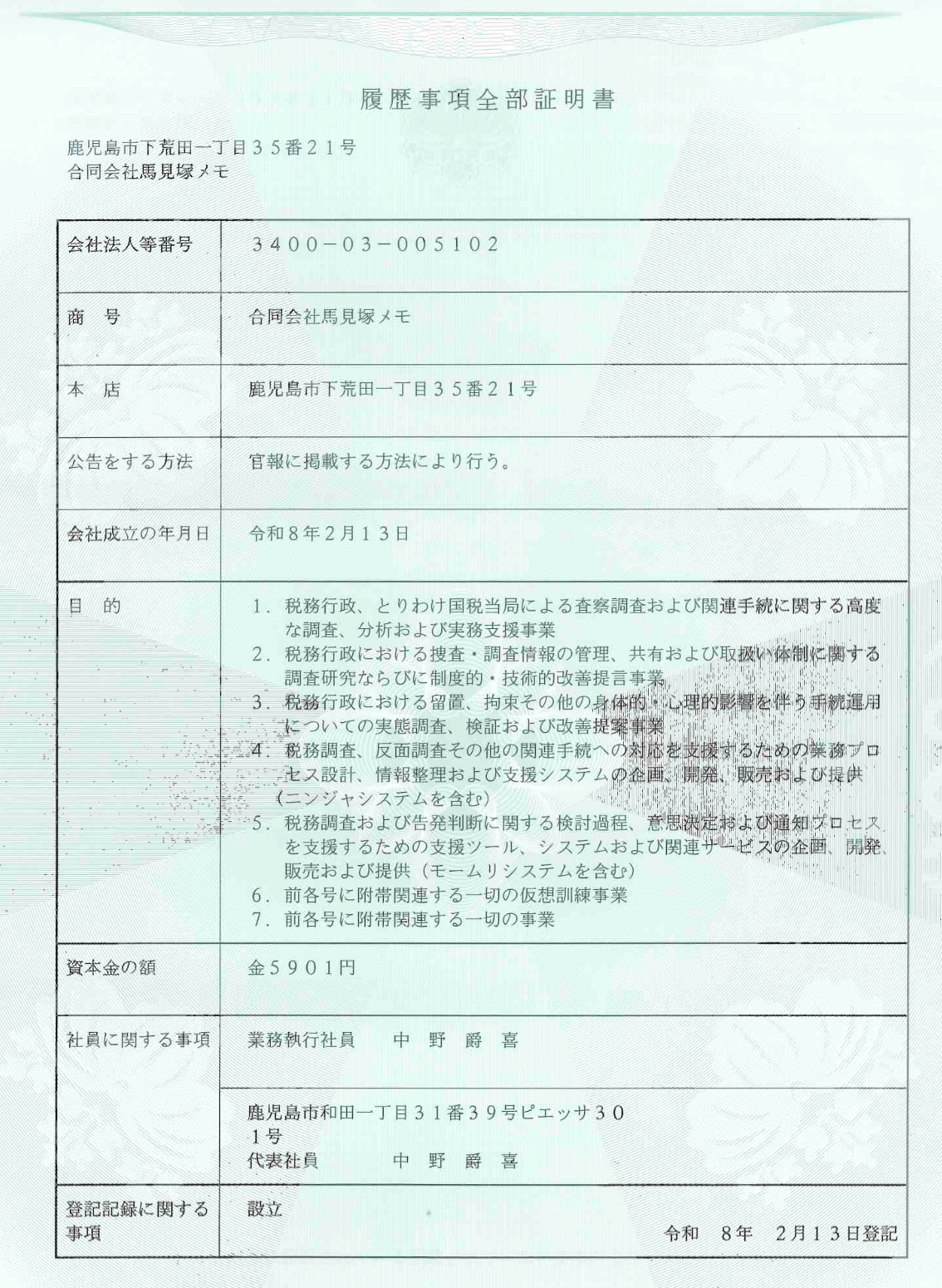
According to the historical all-事項 certificate (Certificate of All Historical Matters), the limited liability company Mamizuka Memo was established on February 13, 2026, and Mr. Toshiyuki Nakano is listed as the representative partner and executive partner. The corporate registration number is 3400-03-005102. It is not merely a name used by someone as an alias; a legal entity with that name is officially registered.
The registered business purposes also include items that overlap with the current issue.
- Investigation, analysis, and practical support regarding tax authorities' criminal investigations and related procedures.
- Research and improvement proposals on the management, sharing, and handling systems for investigation and audit information in tax administration.
- Planning, development, sales, and provision of tools and systems to support the process of deliberation, decision-making, and notification regarding responses to tax audits and third-party investigations, as well as decisions on criminal accusations.
- Virtual training business related to these.
The homepage of the Mamitsuka LLC founded by Defendant Nakanodescribes itself as a "fictional reception support company" and publishes satirical content. The request form also indicates that it is a demo. What the registered corporation does as an actual business and what it considers virtual training or expressive activities are matters that the operator and representative member should explain concretely.
Our union has also received information that Mr. Nakano, along with Mr. Watanabe, is attempting to advance a project titled the "Mamizuka Memo" by leveraging their relationship with the National Tax Agency. To verify both individuals' involvement in this project concept, it is necessary to confirm the background of its establishment, participation in the planning, cost allocation, actual contracts, and attribution of revenues.
In particular, the last mile must explain whether the company's funds, personnel, working hours, equipment, customer information, and business relationships have been used for this corporate entity or related projects. If the business is real, it should demonstrate that reality. If it is a virtual training exercise or a satirical project, it should clarify who is involved in what capacity and how their relationship with the company is organized. Before talking about its distance from the national tax authorities, it needs to clarify its distance from the assets of a listed company.
Reconcile the funding diagrams in the IPO documents and the Mamizuka memo case by case.
The issue in corporate disclosure raised by the Mamizuka Memo is not whether the name of the memo appears in the documents at the time of listing. Rather, it is whether the recorded transactions and control relationships had substance, and whether that substance was accurately reflected in the listing review and explanations for investors.
last mileSecurities registration statement for the 2021 initial public offering applicationThe corporate governance and auditing systems are explained in . By comparing this explanation with the transactions among the company, management, and related corporations depicted in the memo, at least the matters to be verified can be made specific.
- Did the contracts and actual operations correspond to outsourcing fees, advertising expenses, loans, and other fund transfers?
- Were the relationships between the business partner's ultimate beneficial owners or beneficiaries and their officers and the company accurately understood?
- Were necessary explanations and approvals provided regarding related party transactions, conflicts of interest, and transactions with affiliated companies?
- Did the governance systems, such as the Board of Directors, the Board of Corporate Auditors, and internal audit, function as described in the documents?
During the verification, it is necessary to distinguish when the transactions took place, when the memos were created, when management became aware of the facts, and when the documents were filed. The mere existence of a corporate entity with the same name established in 2026 does not prove false statements made in 2021. The question that must be asked is how the company explained the reality of the transactions and business operations that existed at each point in time.
Furthermore, regarding the application documents for new listing, responses to listing examinations, securities registration statements, prospectuses, and annual securities reports after listing, the required disclosure items and actual conditions should be compared for each. Were there explanations that differed from the facts, or omissions of important matters that should have been disclosed? If issues were grasped afterwards, how was the necessity of corrections or additional explanations examined? Only by demonstrating this up to this point can one be said to have explained consistency with the listing documents.
The Tokyo Stock ExchangeListing maintenance criteria related to reassessment due to a breach of written oathIt explains the re-examination process in cases where a violation of the oath items, such as false statements in submitted documents, is recognized as having failed to meet the listing criteria at the time. What was explained during the listing review is not merely an issue of organizing old documents; it also concerns the current credibility of the listed company.
Our union is already questioning the consistency between Mr. Watanabe's actual execution of duties and the explanations given during the listing review. The fund diagram in the Mamitsuka memo should also be examined from the same perspective of not just titles, but who gave the instructions, who approved them, and who profited.
What did the Board of Directors, the Board of Corporate Auditors, and the Audit and Supervisory Committee deliberate on?
In the listing application documents, the governance system describing the collaboration among the Board of Directors, the Board of Corporate Auditors, the Internal Audit Office, and the accounting auditors for the last mile was explained. Meanwhile, the currentOfficial Board Member Introductionincludes outside directors who are Audit and Supervisory Committee members. Therefore, it is necessary to examine both the issue of who audited the transactions during the IPO preparation period and the issue of how the current Audit and Supervisory Committee is handling the Mamizuka Memo.
Were the memo itself, or the business issues described in the memo, reported to the Board of Directors? Did the Audit & Supervisory Board at the time of the IPO check the relevant transactions and the relationships between the executives and the business partners? Has the current Audit and Supervisory Committee taken over past audit results and conducted an investigation comparing them with the contents of the memo?
What is needed is not merely the conclusion that "appropriate action is being taken." It is to present the transactions investigated, the materials cross-referenced, the timing of deliberations, the factual findings, and the disclosure decisions. If deliberations have already taken place, it should be possible to explain to shareholders and employees through a summary of proceedings and the investigation results, excluding parts necessary for confidentiality.
Regarding matters where Mr. Watanabe's own involvement is at issue, it is also important to determine who set the scope of the investigation and who evaluated the results. Was the investigation concluded solely based on the explanations of the party being investigated, and was an independent judgment from the relevant directors ensured? Clarifying this point is oversight for the purpose of protecting the company.
Having committees drawn on an organizational chart is one thing, but those committees actually facing problems is another. We cannot have a governance structure presented to the market suddenly becoming useless as a guide only when inconvenient matters arise.
Did the audit firm examine the memos? The records on the auditing side are also subject to verification.
The funding diagram in the publicly released Mamizuka memo also bears the name of Faith Audit Corporation. Rather than treating this mention as proof of wrongdoing by the audit corporation, it is necessary to inquire when the corporation itself became aware of the mention and how it verified the facts.
Faith Audit Corporationself-disclosed quality control systemThen, it explains how to respond to situations suggesting material misstatements due to fraud, make professional inquiries both inside and outside the corporation, conduct audit reviews, and handle external information and suspicions. If so, it raises the question of how the mechanism was operated regarding materials that even include its own name.
Regarding the audit firms for the last mile of each period, we should not just stop at whether the person in charge looked at the memo. We want it clarified whether they discussed it within the audit team, reported it to the engagement quality control reviewer or quality management department, or consulted with the audit and supervisory board or audit and supervisory committee. If meetings or deliberations were held, please clarify which statements were verified and how they were reflected in the audit plan and audit opinion.
Regarding descriptions concerning the auditors themselves, a verification system is also necessary that does not leave confirmation solely to the person in charge. Were confirmations conducted by independent personnel or external experts? If the contents of the materials are to be denied, upon which transaction records or objective materials was that denial based? Simply having the company and the audit firm cite each other's explanations in a circular manner does not constitute verification.
The Kumamoto Regional Taxation Bureau must explain the circumstances under which it was distributed as national tax documentation.
Regarding the information that it was circulated by the Kumamoto Regional Taxation Bureau as the matter concerning Mr. Nakano and Mr. Watanabe, an explanation from the administrative side is also indispensable. Did the Regional Taxation Bureau create or acquire the Mamitsuka Memo as part of its official duties, and did it use and retain it as an organization? If it was disclosed to an outside party, under what authority and for what purpose was it handled? It is necessary to confirm these points specifically.
Paragraph 2 of Article 2 of the Act on Access to Information Held by Administrative Organs defines the basic requirements for administrative documents as follows:
In this Act, "administrative document" means any document, drawing, and electromagnetic record (omitted in the middle) that has been prepared or obtained by an employee of an administrative organ in the course of their duties, and is held by the administrative organ for systematic use by the employees of the administrative organ.
In other words, even if materials were created by an external party, if the National Tax Agency acquired them in the course of official duties and used and retained them as an organization, they can fall under the category of administrative documents. Conversely, just because something was written by a person knowledgeable in national taxes does not mean it becomes an official document of an administrative organ. What should be judged is not the label "memo," but the actual circumstances of acquisition, use, sharing, and storage.
Both the issue of the nature of this administrative document and the question of whether the contents of the memo are correct must be verified individually. This is because even if documents are held by the National Tax Agency, it does not guarantee that all the evaluations written within them are correct. Regarding Last One Mile and Mr. Watanabe, which money transfers were actually confirmed, which descriptions were judged to be facts, and which descriptions were not adopted—that decision-making process is important.
Although personal information and information that undermines investigations and inquiries have statutory protection, that is not a reason to forego investigating information management issues internally within an organization. In deciding on disclosure requests, reasons for non-disclosure and the feasibility of partial disclosure should be considered, while at the same time, the responsible department should verify whether there were any inappropriate practices in the handling of the materials.
Information linked to the tax authorities is spreading in the private sector, and even a corporation with the same name has emerged. That is precisely why the Kumamoto Regional Taxation Bureau itself needs to clarify the boundary between what was done as an official public duty and what was done independently by a private individual. Administrative credibility must not be used as wrapping paper to obscure where accountability lies.
Open Questions by Mr. Tamaki Nakano and Mr. Makoto Watanabe to the Company, Audit Corporation, and Kumamoto Regional Taxation Bureau
The Last One Mile Labor Union requests the relevant parties to provide specific explanations regarding the following matters. For matters that have already been investigated, reported, or made public, please provide the implementation timing, scope, conclusions, and published materials.
- Did the Kumamoto Regional Taxation Bureau create or acquire the Mamizuka memo or materials of the same content in the course of its duties, and utilize and retain them as an organization? Can it explain whether there is the fact that they were used for distribution or explanation to outsiders, as well as the purpose, responsible department, and approval procedures?
- Has the Kumamoto Regional Taxation Bureau investigated the information that materials were circulated regarding the cases of Mr. Masayoshi Nakano and Mr. Makoto Watanabe? Regarding the "last-mile" transactions and Mr. Watanabe's involvement as stated in the memo, what scope of verification was conducted?
- Can Mr. Kakuki Nakano explain the purpose of the establishment of Mamizuka Memo LLC, its actual business operations, the scope of virtual training and satirical projects, and its relationship with the operation of the website of the same name? Is Mr. Makoto Watanabe involved in the establishment, planning, cost-sharing, operations, or profit distribution?
- What business relationships do Mr. Nakano and Mr. Watanabe have with national tax officials or related personnel regarding the same corporation or related projects? Can they explain the distinction between official commissions, partnerships, or approvals and their involvement as private citizens?
- Did the last mile provide its own funds, personnel, equipment, information, or business relationships to the same corporation or a related initiative? If such provision exists, can you demonstrate the company's purpose, contracts, consideration, approval procedures, and considerations regarding conflicts of interest?
- When did the Board of Directors become aware of the Mamizuka Memo or the stated issues, and what did it deliberate? Regarding the audit of the relevant transaction by the Board of Corporate Auditors at the time of the listing and the re-verification by the current Audit and Supervisory Committee, can you provide the implementation details and conclusions?
- Did the company cross-check each transaction in the memos against the listing application documents, responses to listing reviews, securities registration statements, prospectuses, and post-listing annual securities reports? Who determined whether there were any misstatements or omissions of material facts, and based on which documents?
- Did the audit firms for each period hold discussions within the audit team regarding the memo, report to the engagement quality reviewer and the quality control department, and consult with the Audit & Supervisory Board or Audit and Supervisory Committee? Did Face Audit Corporation conduct fact-checking to ensure independence regarding the parts bearing its name?
- How did the company determine the necessity of consulting and reporting to the lead managing underwriter, the Tokyo Stock Exchange, and the competent authorities regarding this matter? If there are any matters determined not to require announcement to shareholders and the market, correction of disclosure documents, or additional explanation, can you explain the reasons and the decision-making entity?
- Have the company, the audit firm, and the Kumamoto Regional Taxation Bureau preserved each version of the memos they hold, related transaction materials, meeting and review records, and operational sharing history? Are they willing to conduct an independent verification from related parties and explain the results to the extent that can be publicly disclosed under the law?
What the Last One Mile Labor Union demands is not diffusion, but verification and disclosure.
Japan Exchange RegulationPrinciples for Responding to Corporate Scandals at Listed CompaniesIt places importance on investigating the causes when suspecting a scandal, as well as on the independence and neutrality of the investigation. Regarding information disclosure, rather than withholding any explanation until a final disciplinary action is decided, it expects transparency to be ensured from the stage of initial awareness as needed.
Even in light of the direction indicated by this guideline, what the last mile must explain is not the prediction of arrests or indictments, but rather the company's own investigation and decision-making. Our union demands the following response.
- Preserve the original and all versions of memos, related contracts, payment and accounting materials, listing review documents, and meeting and discussion records. Also check the operation of automatic deletion and retention periods to ensure that materials necessary for verification are not lost.
- Establish an investigative framework independent from Mr. Watanabe, Mr. Nakano, and the transactions and audits subject to verification. Cross-check each entry in the memos with objective materials, and organize the correct parts, incorrect parts, and unconfirmable parts along with their reasons.
- Verify the consistency between the IPO and post-IPO disclosure documents, and determine the necessity of reporting, corrections, and timely disclosure in accordance with laws and exchange regulations. Provide necessary explanations regarding the scope of the investigation, progress, conclusions, and the reasons for disclosure decisions.
- Prevent retaliation against employees and collaborators who report facts for the public interest, and ensure channels are available for them to provide information. In the event that losses or damages related to the company are identified, consider the locus of responsibility and recovery measures as well.
Anyone with information regarding the relevant transactions should preserve lawfully held contracts, remittance records, explanatory materials, and business instructions in a way that clearly shows dates and the sequence of events. Rather than repeating the conclusions of notes, records that show what those arrows represent and how funds actually moved from whom to whom are far more important.
For information regarding investment fraud and fund recovery, please contact a separate organization from our association.Nakano Toshiharu Victims AssociationIt also aims to consolidate damage reports and verify the roles of related parties and the flow of funds. It is necessary to proceed based on objective materials without separating the demand for company disclosures from the recovery of individual damages.
Before telling other companies to "make it public," state your own decision.
Our union is addressing the issue raised by an internal whistleblowing report from the secretary of Watanabe, an executive at Last One Mile, regarding contacts made by Watanabe and others demanding that another company publish fact-checking results, with the implication that failure to do so would result in reports to relevant authorities. If they are going to pressure another company to make a public statement, they cannot escape explaining what they investigated regarding their own materials and on what basis they decided what should be made public.
The Mamizuka memo, which was circulated by the Kumamoto Regional Taxation Bureau regarding the matters of Mr. Nakano and Mr. Watanabe. The corporation registered under that name, with Mr. Nakano as the representative partner. And the relationship between last-mile delivery and Mr. Watanabe as depicted in the memo. What is necessary to verify these is not talk of who is close to whom, but rather records of transactions, meetings, audits, reports, and disclosures.
Registering a company name and fulfilling corporate accountability are different tasks. If the "Mamizuka Memo" is to be used as the name of the business, we also demand a specific explanation regarding the issues that name has pointed to.
What shareholders and employees need is not a forewarning of who will be arrested, but a report on what their company knew, what it investigated, and what it concluded. Before passing the Mamizuka memo on to the next person, I want that report delivered to the market.