
The profound gap between the LINE messages talking about the "soul" to the victim and reality
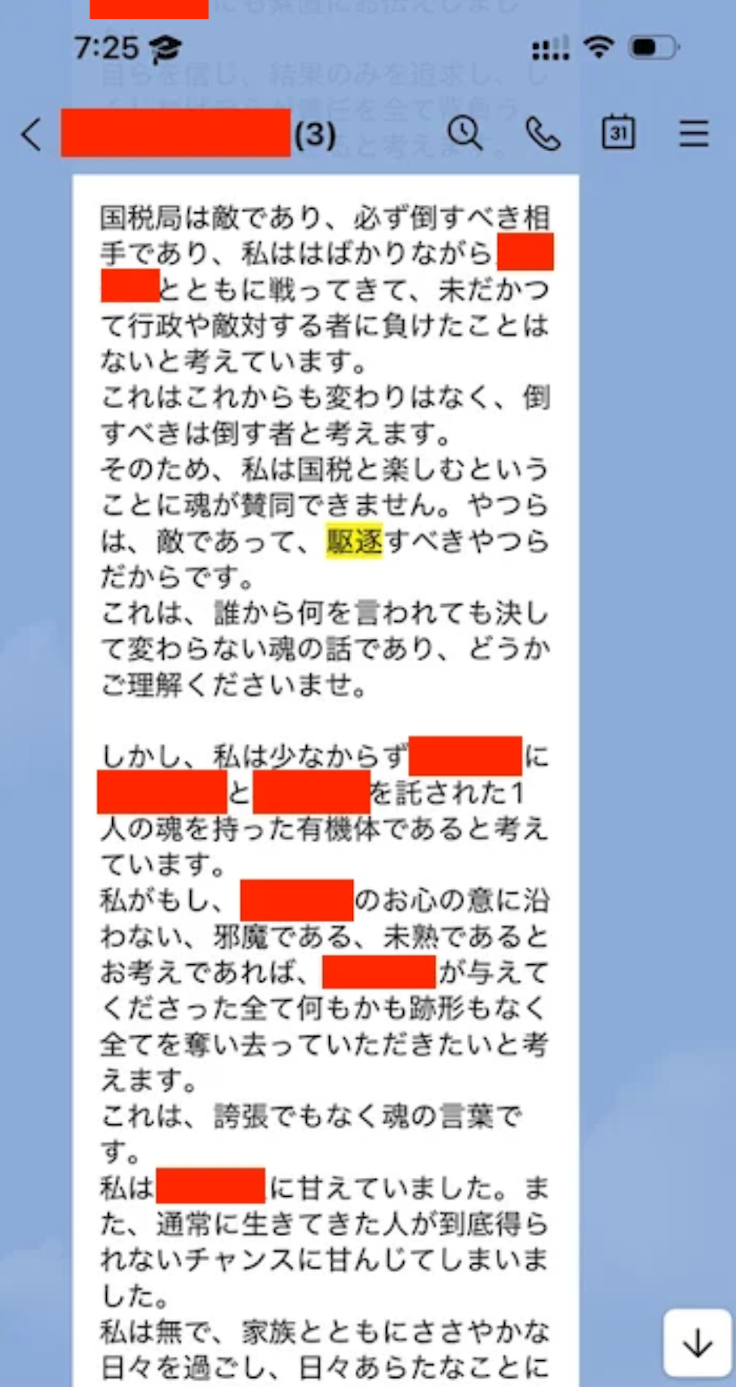
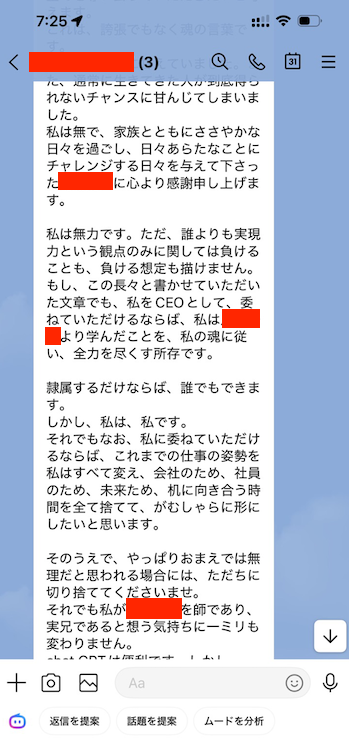
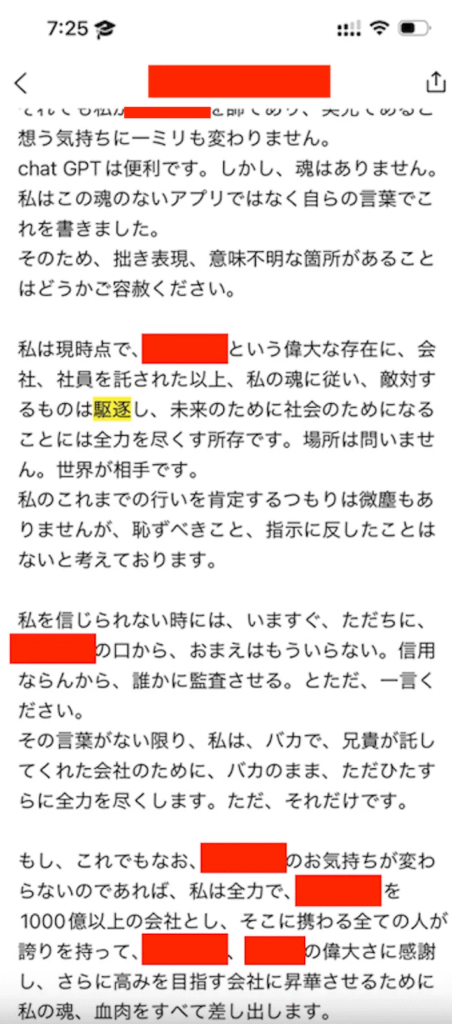
The Last One Mile Labor Union has been provided with screenshots of a LINE message allegedly sent by Defendant Kazuyoshi Nakano to concerned parties appealing about the damages on the ground just before he left Cambodia.
There, words suggesting strong loyalty, a sense of mission, and self-sacrifice—such as "the National Tax Agency is the enemy," "must be eradicated," "I am powerless," "obey the soul," and "make the company worth 100 billion yen or more"—are repeated over and over. Furthermore, it declares acceptance of audits and a full commitment to the company, its employees, and the future.
However, based on the specified published articles and information provided by related parties, regarding Defendant Nakano at the time the message was sent, there are claims that he was accused of massive fraud and embezzlement in Japan's neighboring country of Cambodia and left the country around April 8, 2026. There is an enormous gap between the words written in the LINE message—"soul," "gratitude," "audit," and "for the company"—and the allegations of fraud and suspicion of fleeing.
Of note are the significant discrepancies between word and deed left in writing, self-justification, expressions that blur the locus of responsibility, and a structure that emphasizes absolute loyalty to someone.
We must not confuse published facts with information that requires verification.
The criminal proceedings of Defendant Toshiyuki Nakano that can be confirmed through news reports
According to Kagoshima Television reports, defendant Tamaki Nakano was prosecuted on June 18, 2026, for crimes including violations of the Consumption Tax Act, and on the same day, was re-arrested on suspicion of fraud and attempted fraud for allegedly defrauding an independent administrative institution of 10 million yen in subsidies. The district public prosecutors office has not disclosed whether he admits or denies the charges. It is also reported that, citing an accomplice having moved abroad, the office requested the Ministry of Foreign Affairs to issue an order for the return of the passport.
Last Mile and Satoshi Saito's public position
According to LAST ONE MILE Co., Ltd.'s official website, Makoto Watanabe is currently listed as Representative Director, Chairman and CEO. Additionally, the official executive biography of another listed company states that Satoshi Saito is a certified public accountant and assumed the position of General Manager of the Corporate Planning Office at LAST ONE MILE Co., Ltd. in August 2020.
Matters submitted to the association that still require verification
On the other hand, the damage of approximately 700 million yen in Cambodia, the overseas movement around April 8, 2026, the support for hiding within Japan, multiple meetings with Mr. Makoto Watanabe and Mr. Satoshi Saito, and the statement that "we have the Kumamoto Regional Taxation Bureau, the Kagoshima District Public Prosecutors Office, and the Fukuoka High Public Prosecutors Office on our side" are items to be verified based on information provided to our union and the designated articles.
Since serious doubts have arisen, it is necessary for the parties involved and investigative agencies to specifically explain the dates and times, locations, communications, funds, meetings, seized items, and whether or not information was shared.
Is this a conspiracy theory?—Verifying the suspicion of a "manufactured story"
Our union is raising the following hypothesis: Did Defendant Nakano travel to Japan to evade investigation in Cambodia, repeatedly contact and meet with Makoto Watanabe and Satoshi Saito, and subsequently become integrated into the criminal case scenario drawn up by Japan's national tax authorities and prosecutors? Furthermore, we question whether, in that process, the explanation positioning another individual as an "accomplice" was prioritized over the overseas damages and the whereabouts of funds that are disadvantageous to Defendant Nakano.
This is a hypothesis at this point. However, the very people who hold the information necessary to refute this hypothesis are Defendant Nakano, Mr. Makoto Watanabe, Mr. Satoshi Saito, the Kumamoto Regional Taxation Bureau, the Kagoshima District Public Prosecutors Office, and the Fukuoka High Public Prosecutors Office. If those involved remain silent, if the investigative authorities refuse to provide any explanation on the grounds of it being an "individual case," and if suspicions of information leaks are not even investigated, it is only natural that suspicions grow that "this might be a fabricated story."
Three possible options
- Defendant Nakano merely uttered falsehoods or exaggerations, claiming to have "the National Tax Agency and the public prosecutors on his side" in order to make his own position appear greater.
- Mr. Watanabe or Mr. Saito assisted Defendant Nakano with post-return living arrangements, communication, legal responses, and other matters, but the investigative decisions of the National Tax Agency and the public prosecutors were made independently.
- Information was inappropriately shared between private-sector individuals and the national tax authority and prosecutors, allowing Defendant Nakano and the Last One Mile side to learn the timing and storyline of the investigation in advance and exploit them.
What is the truth is not determined by mere impressions. It should be judged based on communication history, location data, meeting records, remittance history, device analysis, seizure and return records, and the identification of individuals who had access to investigative information.
National tax and prosecution scandals are not proof of wrongdoing. However, they destroy trust.
Recently, a case was reported where an official of the Osaka Regional Taxation Bureau allegedly transmitted 259 items of taxpayer information to an individual posing as a police officer, resulting in disciplinary action and referral to prosecutors. The leakage of national tax information to the outside is not an abstract fantasy, but a problem that can actually occur.
Also, regarding the Pressance false accusation case, Prosecutor Daisuke Tabuchi, who made remarks such as "Don't underestimate the prosecution" and "I'm putting my life on the line" during interrogations, is charged with the crime of abuse of authority by a public official, and pleaded not guilty at his first trial in July 2026. Whether the prosecution's organizational monitoring system was functioning is also considered a major focus of the trial.
These incidents are not evidence that the Kumamoto Regional Taxation Bureau or the Kagoshima District Public Prosecutors Office acted wrongfully in this case. However, they do show that unconditional trust—such as assuming "they won't leak information because it's the national tax agency," "they won't fabricate a narrative because it's the prosecution," or "they won't give inaccurate explanations because they are representatives of a listed company or certified public accountants"—is untenable. What increases the credibility of the suspicions is not past scandals themselves, but the attitude of those involved in this case who continue to refuse to provide explanations.
The danger of control and self-justification shown in Defendant Nakano's LINE messages
In the provided LINE messages, words such as "exterminate those who oppose us," "soul," "absolute loyalty," and "surrendering everything" are repeated. This indicates the danger of placing loyalty to a specific individual and a sense of personal mission above objective standards such as laws, contracts, accounting, and explanations to victims.
Moreover, while he wrote, "If you tell me to submit to an audit, I will," there is no evidence—at least from publicly available information—that he has explained his actions or funds in a way that can be verified by a third party. While humbling himself by saying, "I am powerless," his writing also speaks of "taking on the world," "having no intention of losing," and "making it a 100 billion yen company." Careful verification is required to determine whether these are words taking responsibility or words meant to emotionally bind the other party's judgment.
If a person who uses such language was acting against the backdrop of the authority of Makoto Watanabe, representative of a listed company, certified public accountant Satoshi Saito, and the national tax and prosecutorial authorities, it is extremely difficult for the victim to fight back as an individual. That is precisely why the Board of Directors, the Audit and Supervisory Committee, and investigative agencies of Last Mile, Inc. have the responsibility to investigate—not based on formal titles, but regarding who actually gave instructions, who managed the funds, and who profited.
last mile, Makoto Watanabe, Satoshi Saito, open questions to the national tax authorities and the prosecution
Questions for Makoto Watanabe and Last One Mile Inc.
- Did Mr. Watanabe or any officers or employees of Last One Mile assist defendant Nakano in departing for Cambodia, securing a place to stay in Japan, transportation, communications, funds, devices, or contacting legal counsel?
- Did Mr. Watanabe meet or communicate with Defendant Nakano after the latter's return to Japan? Please clarify the date and time, location, attendees, and agenda.
- Did Mr. Watanabe receive investigative information regarding the Kumamoto Regional Taxation Bureau, the Kagoshima District Public Prosecutors Office, and the Fukuoka High Public Prosecutors Office from Defendant Nakano or Mr. Satoshi Saito?
- Was there no intention to divert public attention away from overseas incidents and funding issues disadvantageous to Last One Mile Inc. or Mr. Watanabe by exploiting the arrest of Defendant Nakano and the press release?
- As a listed company, will you conduct an independent third-party investigation into your relationship with Defendant Nakano, the overseas damages surrounding him, and your contact with investigative agencies?
Questions for Satoshi Saito
- After Defendant Nakano's return to Japan, were there any meetings or communications with him and Mr. Makoto Watanabe?
- Did you provide Defendant Nakano with advice regarding taxes, accounting, fund transfers, statements, and investigative responses?
- Have you communicated or consulted with officials from the Kumamoto Regional Taxation Bureau, the Kagoshima District Public Prosecutors Office, or the Fukuoka High Public Prosecutors Office regarding the persons or materials related to this case?
- As a former Last One Mile Management Planning Office Head and a Certified Public Accountant, are you willing to cooperate in verifying related funds and transactions, and to disclose documents?
Questions for the Kumamoto Regional Taxation Bureau, the Kagoshima District Public Prosecutors Office, and the Fukuoka High Public Prosecutors Office
- Did you investigate the visits, communications, and financial relationships of Defendant Nakano, Mr. Makoto Watanabe, and Mr. Satoshi Saito?
- Have you investigated the possibility that information regarding the arrest, search, accusation, press release, or request for passport return was leaked in advance to the defense counsel of the accused Nakano or individuals related to Last One Mile?
- Have you received evidence, reports of harm, and financial documents from stakeholders and local investigative agencies reporting damages in Cambodia? If not, why have you not made inquiries?
- Have you investigated the authenticity, creation background, and leakage route of the "Mamizuka Memo," which is rumored to be circulating externally?
- Who was designated as an accomplice, and who was excluded from the scope of the investigation? How do those decisions correspond with the objective evidence?
- How did you verify the credibility of Defendant Nakano's statements and explanations, including the self-justification and discrepancy between words and deeds that appeared on LINE?
The way to end conspiracy theories is not silence, but the disclosure of records.
This might be a conspiracy theory. However, simply laughing it off as a conspiracy theory does not make the doubts disappear. If they did not meet, they should answer that they did not meet. If they are not supporting them, they should answer that they are not supporting them. If they did not leak investigation information, they should show the access logs and investigation results. If they investigated the damage in Cambodia, they should disclose the implementation of the investigation to the extent possible.
The words "soul" and "loyalty" found in Defendant Nakano's LINE messages will not get the stolen money back. What is needed are verifiable facts: dates, amounts, accounts, devices, login history, meeting records, and location information.
The Last One Mile Labor Union will not let this case end with the individual criminal responsibility of Defendant Nakano alone; it will continue to ask society who supported Defendant Nakano, who managed the funds and information, who ultimately profited, and whether the National Tax Agency and the prosecutors conducted a fair investigation into the full picture.