
On August 10, 2026, in a courtroom of the Tokyo District Court, audio and video recordings of interrogations conducted by the Special Investigation Department of the Tokyo District Public Prosecutors Office were played. In the footage reported by the media, the prosecutor in charge can be heard shouting at a defendant who was remaining silent, saying, "Being hostile to the prosecutors office means you're organized crime," and pressuring the defendant for a statement by bringing up the impact on those around them, warning, "Don't drag your family and people around you into this."
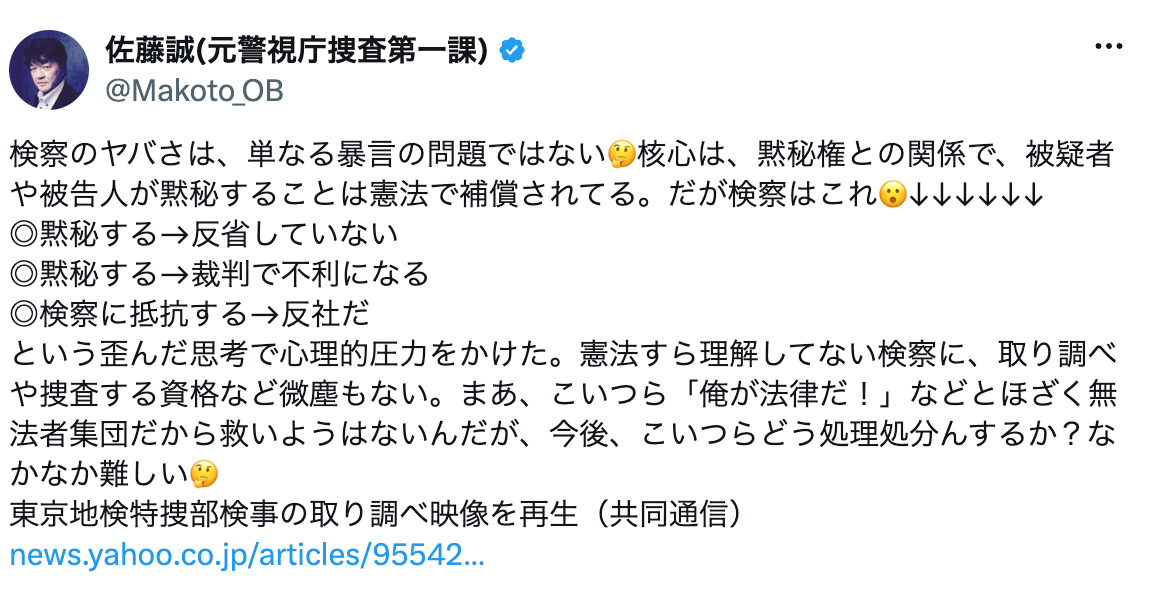
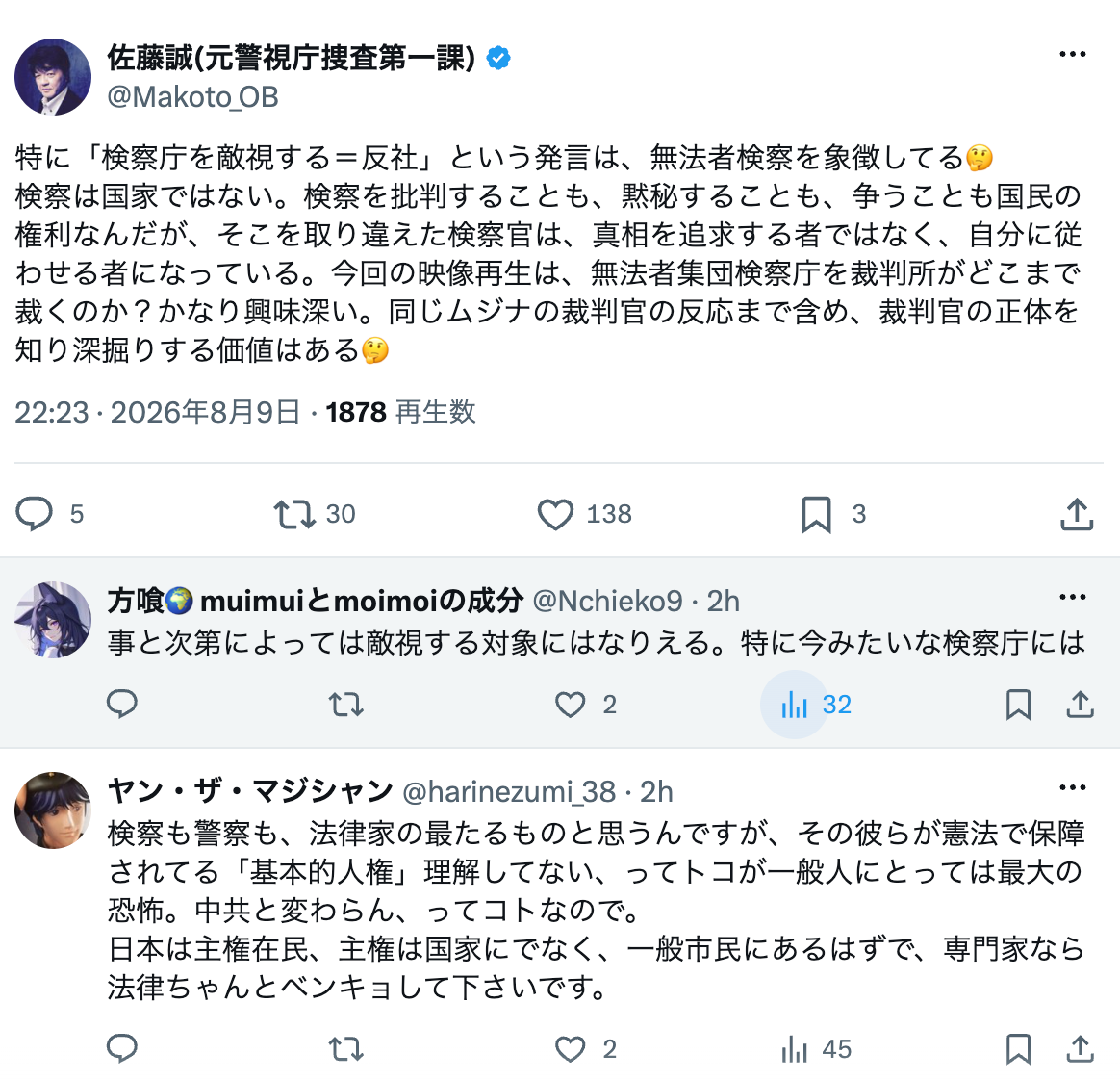
I featured this video.Makoto Sato's X postとContinued X postsis drawing attention. The idea of criticizing prosecutors and calling someone who exercises their right to remain silent an "anti-social force" seems designed to replace dissent against public authority with personal attacks and force the opponent to submit.
Recordings and documents preserved by the Last One Mile Labor Union include records stating that Makoto Watanabe, Representative Director, Chairman, and CEO of Last One Mile Inc., said regarding individuals who do not obey him, "I'll kill you," "I'll ruin you even if it means stabbing each other to death," and "I'll destroy the whole company." Furthermore, Watanabe reportedly did not deny his ties to anti-social forces, but instead boasted about them to those around him for many years as tales of valor, saying things like, "I'll get what I want even by using anti-social forces," and "I seized the rent receivables from the Trump of Himeji."
Those who are hostile to the public prosecutors' office are antisocial forces. Those who make an enemy of Makoto Watanabe will be killed, crushed, or delisted. Backed by authority and personal connections, labeling those who talk back as "enemies" and using their lives, families, assets, and companies as attack material to force submission—the structures are strikingly similar.
In this article, we will connect the dots regarding the allegations of ties to antisocial forces surrounding Mr. Makoto Watanabe, which we have previously covered in pieces, into a single coherent narrative. This will include the issues involving the "Himeji Trump" and the asset management company R-Co reported by Nikkan SPA!, the public background of Riva Facilities Co., Ltd., audio recordings and messages preserved by our union, and a newly provided recording indicating that "tens of millions of yen in corporate assets were invested to obtain documentation proving no ties to antisocial forces."
Public documents and recordings used for this verification
Makoto Watanabe's suspected ties to antisocial forces are not on a level that arose from just a single anonymous post. Testimonies from multiple sources with different time periods and positions, audio recordings alleged to be of his own statements, public reports, and IPO application documents all point to the same profile and pattern of behavior.
- The interrogation video by the Special Investigation Department of the Tokyo District Public Prosecutors Office, which was played in court on August 10, 2026, and the series of X posts covering it.
- In August 2020, Nikkan SPA! reported on the rent dispute involving Goro Okawa, known as the "Trump of Himeji," and Mr. W, the representative of the asset management company R.
- The background of Makoto Watanabe, listed in the listing application documents of Last One Mile Inc., as an advisor at SHI Co., Ltd. and Representative Director of Riva Facilities Co., Ltd.
- Recordings capturing statements such as "I'll take what I want, even if I have to use anti-social forces" and "I snatched the rent receivables from the Trump of Himeji," along with multiple testimonies.
- A past official document pointing out involvement in requesting trouble resolution from a designated organized crime group executive, hospitality on overseas trips, money laundering, and capital management.
- Recordings and messages recording intent to harm opponents, such as "I'll kill you," "I'll drag you down even if it kills us both," "I'll destroy the whole company," and "I'll drive you to delisting."
- A new recording in which Mr. Watanabe allegedly states that tens of millions of yen from Last Mile's assets were invested to create documents proving no ties to antisocial forces.
We must treat facts verifiable through public documents, recordings preserved by our union, and statements written in documents as distinct. However, given that the same issues—the use of antisocial forces, intimidation of the other party, fund management, and personal use of company assets—repeatedly emerge from completely different times and channels, it is no longer a stage where Last One Mile's Board of Directors and Audit and Supervisory Committee can let the matter pass in silence.
"Hostility toward the public prosecutors office makes you anti-social" and "Making an enemy of me means elimination" are two sides of the same coin
Video playback in court reported by Kyodo News on August 10, 2026Now, a scene has come to light in which a prosecutor from the Tokyo District Public Prosecutors Office's Special Investigation Department pressures a defendant remaining silent with the following intent:
To treat the Prosecutor's Office as an enemy is to be anti-social.
The public prosecutor's office is not the state itself, and prosecutors are not immune to criticism. Exercising the right to remain silent, refusing to make statements, and challenging the prosecution's investigative strategy are not, in and of themselves, grounds for being labeled an antisocial force. Nevertheless, if dissent is branded as "antisocial" and compliance is coerced by invoking the impact on family and those around them, this is not an interrogation, but rather the sorting of friends and foes by public authority.
The recordings preserved by our union regarding Mr. Makoto Watanabe show the same way of thinking expressed in even more explicit terms.
- A statement to the effect of "I'll kill you."
- A remark to the effect of "I'll drag you down with me, even if it kills me."
- A remark to the effect of, "If you don't do as I say, I'll destroy the whole company."
- Statements to the effect of "definitely forcing" an independent listed company "to delist."
- A statement made against an opponent, to the effect of "exposing all their wrongdoings, having them arrested, and relentlessly cornering them."
The prosecution labels those who are hostile to them as anti-social forces. Mr. Watanabe states that he will kill, crush, have arrested, or delist anyone he deems to have made an enemy of him. Neither verifies the other party's actions based on facts or laws; instead, both substitute "whether they obey us" as their standard for good and evil.
This commonality goes beyond mere roughness of language. Society must take it seriously precisely because it is uttered by individuals who are in a position to inflict actual harm on others, backed by organizational authority, points of contact with investigative agencies, corporate assets, and personal connections with antisocial forces.
Before denying his ties to anti-social forces, Makoto Watanabe used to talk about them himself as tales of his own bravado.
The most serious aspect of Mr. Watanabe's alleged ties to anti-social forces is not a rumor made up by someone on the outside, but rather the existence of recordings and multiple testimonies showing that Mr. Watanabe himself spoke to those around him about his connections to and utilization of anti-social forces.
These are reportedly statements that Mr. Watanabe repeatedly made at dinner parties and other occasions. Our union has been provided with recordings and multiple independent testimonies regarding some of these statements.
- A remark to the effect that "you can easily trap someone by pretending to have forgotten on purpose."
- Statements to the effect that he was also the one who seized the rental claims from Trump of Himeji.
- A remark to the effect of, "I'll get what I want, even if I have to use antisocial forces."
- Similar to the Himeji case, statements to the effect that even if a problem occurs, "it's fine because we also use yakuza."
- A boastful tale about resolving a trouble with yakuza associates by pulling out a Japanese sword.
It is not uncommon for someone suspected of having ties to anti-social forces to later claim, "There is no connection." However, in this case, that same individual reportedly boasted about using anti-social forces to gain profits, having ties to high-ranking yakuza executives, and using gangsters if necessary, sharing these stories as tales of heroic feats to demonstrate their own problem-solving abilities.
If it were a slip of the tongue that happened at a single drinking party, it could be corrected along with the specific context. However, when the same remarks appear across different times, different people involved, and different documents, and furthermore, even statements about killing, eliminating, or delisting opponents are recorded, then dismissing it all with a single phrase like "it was a joke" makes both the frequency and content of the jokes, as well as the real-world stakes, far too heavy to brush aside.
Mr. W of Nikkan SPA! and R Company overlap with the backgrounds of Mr. Makoto Watanabe and Riva Facilities Co., Ltd.
The article on Goro Okawa, the "Trump of Himeji," published by Nikkan SPA! in August 2020The text then introduces Mr. Okawa's claim that asset management company R, which was entrusted with managing payments for rental properties owned by Mr. Okawa, stopped sending the promised monthly remittance of approximately 220 million yen.
According to the article, Mr. Okawa and Company R concluded a master lease agreement in 2019, under which Company R was responsible for collecting rent from existing tenants, deducting management and maintenance fees, and remitting the remaining balance. Mr. Okawa explains that after receiving a payment of approximately 32 million yen in April 2020 and about 6 million yen in May of the same year, the remittances stopped, leaving the rental income in the hands of Company R.
On the second page of the article, the representative of Company R is referred to anonymously as "Mr. W" and is described as someone who served as an advisor for minpaku and hotel businesses targeting South Korean tourists in Fukuoka. Nikkan SPA! does not mention Mr. W's real name nor the official name of Company R.
Meanwhile, multiple stakeholder documents provided to the Last One Mile Labor Union identify Mr. W in this article as Makoto Watanabe, and Company R as Riva Facilities Inc. Furthermore,Lastmile Inc.'s application documents for initial public offeringIt states that Mr. Watanabe served as an advisor to the hotel business company SHI Co., Ltd. in April 2016 and as Representative Director of Riva Facilities Co., Ltd. in June 2019.
The characteristics of Mr. W indicated by Nikkan SPA!, the timing of the contract between Company R and Mr. Ōkawa, and Mr. Watanabe's public career specifically overlap. When this is combined with the recording in which Mr. Watanabe himself reportedly said, "I snatched the rent receivables from the Trump of Himeji," and the statement that "I'll get it even by using antisocial forces," Last One Mile Inc. cannot simply brush it off with the attitude that it is unrelated because it is an anonymous article.
Mr. Watanabe and the company should explain, based on contracts and deposit/withdrawal records, who Mr. W and Company R are, how Riva Facilities Co., Ltd. was involved in Mr. Okawa's property management and rent collection, and to what extent Mr. Watanabe directed negotiations, contracts, bank accounts, and creditor relations.
Internal information stating, "We'll use yakuza just like we did with Angelo, so it's fine."
There is a statement that when Mr. Watanabe forcibly changed Last One Mile's sales policy, he told the employees to the following effect:
Even if something happens, I'll use the Yakuza like I did with Angelo, so it'll be fine.
This statement does not show someone being ashamed of their ties to antisocial forces and hiding them. Rather, it shows them proudly displaying it as business leverage—the idea that even if a business partner resists, they can force the issue because they have the means to use antisocial forces.
Other stakeholder materials repeatedly contain the following information regarding points of contact with a designated organized crime group member, whom they are said to have met through the Himeji project.
- Information that the resolution of problems or protection regarding the Himeji case was requested of an individual regarded as an executive of a designated organized crime group.
- There is information that he continued his relationship with the same individuals thereafter, repeatedly sharing meals and attending meetings with them.
- Information emerged that multiple related parties were entertained with an overseas trip as a reward for resolving the trouble.
- Information that they undertook the laundering and management of funds alleged to originate from anti-social forces.
- Multiple testimonies indicate that Mr. Watanabe repeatedly bragged about these connections and events while eating and drinking.
- Multiple testimonies stating that the spouse of one's private secretary has a criminal record for fraud and still maintains close ties with antisocial forces.
- Multiple testimonies indicate that Mr. Watanabe has employed that individual as an operative for many years.
The informant has clearly stated that they have preserved recordings, messages, multiple testimonies, and financial documents. Some of these have also been provided to our union. Despite this, if what Last Mile Inc. did was not to investigate the substance of the allegations, but rather to hunt for the whistleblower and create materials to protect Mr. Watanabe, it would mean that the anti-organized crime exclusion system was working in reverse from the very beginning.
Last Mile's own anti-social forces policy explains Makoto Watanabe's words and actions.
Last Mile Inc.'s "Basic Policy on Severing Relations with Anti-Social Forces"describes anti-social forces as follows:
Groups or individuals who pursue economic benefits by making full use of violence, force, and fraudulent methods
This is Last One Mile's own definition. Rather than stopping at checking whether someone is listed on a organized crime group registry, it also targets individuals who pursue economic benefits through violence, force, or fraudulent methods.
The preserved statements and documents regarding Mr. Watanabe contain notices of intent to cause harm to opponents' lives or to the company, boasting of negotiations using anti-social forces, explanations of trapping opponents to acquire rent claims and businesses, and private countermeasures using company assets. This is a matter that should be investigated by applying the definition put forward by Last Mile Inc. directly to its own Representative Director, Chairman, and CEO.
The company's policy declares that it will not conduct transactions with antisocial forces, will not provide funds, and will cooperate with the police, centers for the promotion of the movement to eradicate violence, lawyers, and others. If employees and business partners are required to undergo antisocial checks, but the representative's own statements, overseas entertainment, fund management, and the Himeji case are not investigated, and only "irrelevant materials" are created for the representative's benefit, then that policy is merely website decoration.
Tokyo Stock Exchange Corporate Code of ConductHowever, listed companies are required to establish systems to eliminate anti-social forces. Eliminating anti-social forces is not just a matter of sending inquiry letters to business partners. Effectiveness is determined by whether, when suspicions are directed at top management, that person is excluded from the investigation and an independent body can review the source materials.
Even in the training video, which all employees were reportedly required to watch and which arguably reveals Mr. Watanabe's attitude as Representative Director the most, the repetition of such outrageous remarks forces us to conclude that his ideology is extremely abnormal.
What does the "document proving no ties to anti-social forces," reportedly created using tens of millions of yen in corporate assets, actually prove?
Newly provided and preserved recordings given to the Last One Mile Labor Union include statements where Mr. Watanabe boastfully speaks to the effect that tens of millions of yen from Last One Mile Inc.'s assets were invested to create materials showing he has no ties to antisocial forces.
If you truly conducted an independent investigation necessary for the company's crisis management, there is no reason to hide it. You simply need to disclose the board of directors' resolution, the involvement of the Audit and Supervisory Committee, the independence of the commissioned party, the contract amount, the scope of the investigation, the reviewed materials, the interview subjects, the conclusions, and the corrective measures to the shareholders, employees, and business partners.
However, as explained in the recording, if Mr. Watanabe is personally boasting about it as "evidence showing he has no ties to anti-social forces," then the company's investigation is being confused with personal self-defense. What an investigative firm or lawyer can produce is a report stating that no ties to anti-social forces could be confirmed within a predetermined scope of time, documents, personal networks, bank accounts, and transactions. It is not a "Certificate of Non-Involvement with Anti-Social Forces" issued for Mr. Watanabe's entire life.
Furthermore, in this case, there already exist recordings, multiple testimonies, and documents alleging that Mr. Watanabe himself boasted about his ties to antisocial forces to those around him. Even if you selectively choose favorable materials and create a document stating "no ties," his own statements, the Himeji matter, overseas entertainment, fund management, and threatening behavior do not disappear. You can buy a document for tens of millions of yen, but you cannot buy a time machine to erase the past.
The cost alone is tens of millions of yen, yet the logic is shockingly elementary. If the shared property of employees and shareholders was used to clean up the mess of the legendary tales the representative has been telling for years, that is not corporate defense—it is an expensive form of self-justification and a social evil.
Article 355 of the Companies Act: Directors shall comply with laws and regulations, the articles of incorporation, and resolutions of shareholders meetings, and shall faithfully perform their duties for the stock company.
If it is an independent investigation for the company, Mr. Watanabe himself should be excluded from the selection of the contractor, the scope of the investigation, interviews, conclusions, and payment approval. If the materials are meant to protect Mr. Watanabe's personal honor or private disputes, there is no reason to have the company bear the costs. In situations where the interests of the company and the individual intersect, how the Board of Directors and the Audit and Supervisory Committee made their decisions is called into question.
Was it an independent third-party investigation, personal legal defense, or reputation scrubbing?
Expenditures on the scale of tens of millions of yen can be broadly classified into the following three natures:
- A formal crisis management investigation in which an independent third party verified the management team including Mr. Watanabe, transactions, network of contacts, and funds to examine the company's anti-social forces risks.
- Personal legal and public relations materials to counter allegations, accusations, and civil or criminal disputes directed at Mr. Watanabe personally.
- A reputation-cleansing document created from the outset to reach a "not involved" conclusion, with the target, period, materials, and related parties all chosen by Mr. Watanabe's side.
In the case of the first investigation, the report should be submitted to the Board of Directors, the Audit and Supervisory Committee, the accounting auditor, major shareholders, and the Tokyo Stock Exchange, and at least an overview of the investigation should be made public. In the case of the second, it should be borne by Mr. Watanabe personally, not by company assets. In the case of the third, the mere fact that tens of millions of yen were paid indicates a failure of internal controls and a waste of company assets.
Regardless of the nature of the information, Mr. Watanabe bragging about it in a private setting does not prove the company's anti-social forces exclusion system. What is necessary is not the cover of a report, but verifiable records of who commissioned it, who paid for it, what was investigated, which evidence was excluded, and who approved the conclusion.
Among the union members who actually heard Mr. Watanabe himself make statements implying a close relationship with anti-social forces, the majority opinion was that it was likely fraudulent material made with slush funds anyway, and the circumstances surrounding the creation of the material should also be properly explained to the public.
Does only the CEO pass the anti-social forces check through self-declaration at a company where employees undergo such checks?
Previously provided internal documents from Last One Mile state that while employees conduct anti-social forces checks for every new transaction, there is a desperate plea noting that if the company president himself were to fail such a check, it would have a catastrophic impact on business partners as well.
For regular business partners, checks are conducted on corporate registration, officers, shareholders, lawsuits, news reports, anti-social forces databases, and sources of funding. Yet, for the Representative Director, Chairman and CEO, it is considered passing if tens of millions of yen are paid to an expert chosen by the individual themselves, resulting in a written statement declaring "there are no ties." Such a system is not an anti-social forces check; it is self-grading where the representative acts as both the examiner and the examinee.
In Mr. Watanabe's investigation, the bare minimum that must be checked is not just querying names in the database. Every specific fact he has spoken about must be cross-checked one by one, including the Himeji project contract and rent, the bank account of Riva Facilities Co., Ltd., meetings with individuals alleged to be affiliated with designated organized crime groups, overseas travel, dining, lodging, remittances, investment management, company expenses, mobile phones, messages, recordings, and retaliation against whistleblowers.
If Last One Mile Co. is truly cutting ties with antisocial forces, the first thing it should cut off is not the person investigating the suspicions. It is the influence that Watanabe, the subject of the investigation, exerts over the investigative materials, company funds, interviews with related parties, contractors, and conclusions.
If you investigate the reporter instead of investigating the report, your anti-organized crime framework is completely upside down.
The documents provided to our union also state that after an internal whistleblower reported Mr. Watanabe's ties to anti-social forces, rather than conducting a proper independent investigation, the company moved to identify, reassign, and eliminate the whistleblower.
If the company hunts down the employee who reported suspected ties to anti-social forces and pushes them away, while the representative accused of these ties uses company assets to compile materials proving their own innocence, then what the company is excluding is not anti-social forces, but rather the person pointing out the relationship with them.
That is not compliance. It is control that uses company systems to protect the executives personally and categorizes anyone with dissenting views as an enemy. This is cut from the same cloth as the logic used by a prosecutor from the Tokyo District Public Prosecutors Office Special Investigation Department when they stated that "viewing the prosecutor's office with hostility makes you anti-social forces."
The Board of Directors and the Audit and Supervisory Committee of Last One Mile Inc. must not simply repeat Mr. Watanabe's own explanations, but must instead verify the date the whistleblowing report was received, the investigative body, the preservation of evidence, whether the whistleblower was searched for, personnel measures, and the approval of expenditures amounting to tens of millions of yen. The longer they remain silent, the stronger the suspicion grows that the company as a whole engaged in reputation laundering and the elimination of the whistleblower.
Open Letter to Makoto Watanabe, Board of Directors, and Audit and Supervisory Committee
- Did Makoto Watanabe make a statement to the effect of, "I will get what I want, even if it means using anti-social forces"?
- Did Mr. Watanabe make statements to the effect that he was also the one who seized the rent claims from the Trump of Himeji?
- Did Mr. Watanabe make statements to the employees to the effect of, "It'll be fine because we'll use the Yakuza like we did with Angelo"?
- Is Mr. W, the representative of Company R who appears in the Nikkan SPA! article, Makoto Watanabe, and is Company R Riva Facilities Co., Ltd.?
- Did Riva Facilities Co., Ltd. enter into a master lease agreement or other property management agreements with Mr. Goro Okawa or his affiliated corporations in 2019?
- Regarding the monthly rent remittance of approximately 220 million yen claimed by the Okawa side, and the reduction or cessation of remittances after April 2020, how did you manage the contracts, deposits, expenditures, and remaining balances?
- In what capacity and with what authority was Mr. Watanabe involved in the negotiations for the Himeji project, creditor relations, property management, rent collection, and account management?
- Did Mr. Watanabe ask a senior member of a designated organized crime group or an individual considered to be an antisocial force to resolve the trouble regarding the Himeji project, provide a bodyguard, or intimidate the opposing party?
- Did Mr. Watanabe or any related companies bear the expenses for those individuals' overseas travel, accommodation, food and drinks, entertainment, or other costs?
- If incurred, please clarify the paying corporation, account title, total amount, approver, and business purpose.
- Has Mr. Watanabe, or a company substantially controlled by him, received, managed, remitted, converted, transferred abroad, or exchanged into crypto assets funds alleged to have originated from antisocial forces?
- Did you make statements to the effect of "I'll kill you," "I'll drag you down even if it kills me," "I'll destroy the whole company," or "I'll drive you to delisting"?
- Did the Board of Directors and the Audit and Supervisory Committee check the recording or messages of the above statements? Please indicate the date of confirmation, the person(s) who confirmed, and the findings of the investigation.
- Who ordered the materials purported to show that there is no relationship between Mr. Watanabe and anti-social forces, when, and to which contractor?
- What was the total amount required for the preparation, research, legal affairs, public relations, and other related costs of the document in question?
- Were assets of Last One Mile Co., Ltd. or its group companies used for the expenses in question?
- When company assets were used, did you obtain board approval, undergo a review by the Audit and Supervisory Committee, and evaluate the transaction as a conflict-of-interest transaction?
- Did Mr. Watanabe himself or individuals close to him involve themselves in the selection of the commissioned research organization, the scope of the investigation, the submitted materials, the interview subjects, or the conclusions?
- Did the investigation include the Himeji case, Riva Facilities Co., Ltd., meetings with individuals identified as affiliated with designated organized crime groups, overseas entertainment, fund management, remittances, audio recordings, documents, and threatening statements?
- If there are any items that were not included in the scope, please clarify the reason.
- Have you submitted the completed report to the Board of Directors, Audit and Supervisory Committee, accounting auditor, major shareholders, Tokyo Stock Exchange, Securities and Exchange Surveillance Commission, or the police?
- If you haven't submitted it, while using tens of millions of yen worth of company assets, whose benefit and what purpose was that material proving?
- Regarding the whistleblowing pointing out Mr. Watanabe's alleged ties to antisocial forces, did you identify the whistleblower, reassign them, dismiss them, or take other disadvantageous treatment prior to investigating the content of the report?
- Will you remove Mr. Watanabe from the investigation materials, company assets, interviews with related parties, and positions where he could influence the investigation results, and conduct an independent re-investigation?
Measures Sought by the Last Mile Labor Union
- Immediately remove Makoto Watanabe from directing investigations, accessing materials, conducting hearings, and selecting contractors regarding allegations of ties to antisocial forces, expenditure of company assets, and handling of whistleblowers.
- To establish a third-party investigation committee with a majority of external members who are independent of the company and Mr. Watanabe.
- Preserve all materials related to recordings, messages, emails, meal records, travel records, accommodation records, company cards, remittances, investments, crypto assets, Riva Facilities Co., Ltd., and the Himeji project.
- Regarding the documents purported to show no ties to anti-social forces, disclose the contractor, contract amount, approval, scope of investigation, source materials, conclusions, and reporting destination.
- If company assets were used for the materials in question and the primary purpose was Mr. Watanabe's personal defense, the expenditure must be reimbursed by Mr. Watanabe himself to the company.
- External experts will re-verify the contract, rent, management fees, creditor response, accounts, and remaining funds between Riva Facilities Co., Ltd. and Mr. Goro Okawa's side.
- Submit materials to the police and other relevant agencies regarding requests for trouble resolution to individuals alleged to be affiliated with designated organized crime groups, overseas entertainment, fund management, and the provision of benefits.
- Report the initiation of the investigation and the overview of the allegations to the major shareholders, the accounting auditor, the Tokyo Stock Exchange, and the Securities and Exchange Surveillance Commission.
- Notify the entire company that investigations, intimidation, personnel disadvantages, suspension of business, and legal threats shall not be directed against current employees, former employees, business partners, and other informants who have reported suspected antisocial forces.
- Publish the investigation report, redacting only the personal information of third parties unrelated to the informants, and disclose the measures to be taken by the Board of Directors and the Audit and Supervisory Committee.
What should have been created for tens of millions of yen was not "unrelated materials," but an independent investigation.
The prosecutor called those who are hostile to the prosecutor's office "anti-social forces." It is said that Makoto Watanabe regards those who do not obey him as enemies and talks about killing, crushing, having them arrested, and causing them to be delisted, and in the past, he spoke of his personal connections and methods like a tale of military valor, saying, "I'll get what I want even if I have to use anti-social forces."
Refusing to listen to counterarguments, dismissing resistance as evil, and enforcing submission through organizational authority or fear—in that sense, Mr. Watanabe and the prosecutor in question are birds of a feather. The difference is that one allegedly used public authority, while the other allegedly used a listed company's assets, personal connections, and ties to anti-social forces.
If Mr. Watanabe has truly severed ties with anti-social forces, there is no need to boast about the documents he selected himself. He should simply hand over everything—the Himeji case, Riva Facilities, overseas entertainment, fund management, audio recordings, threatening remarks, and company expenditures—to an independent third party and make the verification results public.
What should have been produced for tens of millions of yen was not a piece of paper stating that "Makoto Watanabe has no ties to antisocial forces." It was an independent investigation to separate the suspect Watanabe from the inquiry and protect the company, shareholders, employees, and business partners.
If a listed company that vows to sever ties with anti-social forces has its greatest risk sitting in the seat of Representative Director, Chairman, and CEO, and having the company's assets used to compile materials proving his own innocence, the company's basic policy is the ultimate irony.
Even with investments of tens of millions of yen, records of recordings, documents, public materials, remittances, contracts, and statements cannot be erased. To protect not the personal reputation of Makoto Watanabe, but the corporate entity Last One Mile Inc., its employees, shareholders, business partners, and market trust, the Last One Mile Labor Union will continue to investigate the suspicions of antisocial ties and the use of corporate assets.